
Emerald
Emerald combines industrial PAUT, real-time multi-TFM imaging and TOFD with FMC and PWI acquisition in a compact, scalable ultrasonic inspection system.
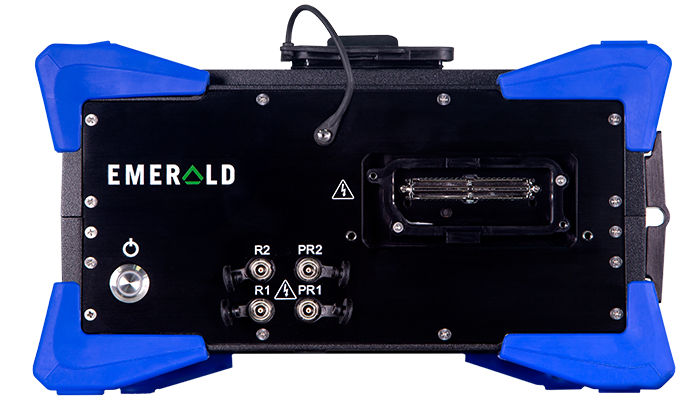
Product overview
Emerald is a compact industrial ultrasonic inspection system combining phased array ultrasonic testing (PAUT), total focusing method (TFM) imaging and time-of-flight-diffraction (TOFD). It is designed for demanding inspection conditions in oil and gas, power generation, in-service railway, manufacturing, heavy industry and aerospace.
Full matrix capture (FMC) and plane wave imaging (PWI) provide acquisition paths for real-time multi-TFM reconstruction onboard or subsequent offline processing. Sectorial total focusing reconstructs live FMC or PWI data into a sectorial sweep focused at each point along the sound path, with summed A-scans available for each angle. Onboard processing supports two simultaneous TFM frames at up to 1M points per frame or eight at up to 256k points per frame.
Double-stage analog amplification and 16-bit digitizing support high amplification without signal distortion. Bipolar pulsers can provide up to 40% more acoustic energy at the same gain settings to support penetration through thick components. The enclosure is designed for IP65, and the five Gigabit per second Ethernet link supports cables up to 100 meters (300 feet) long.
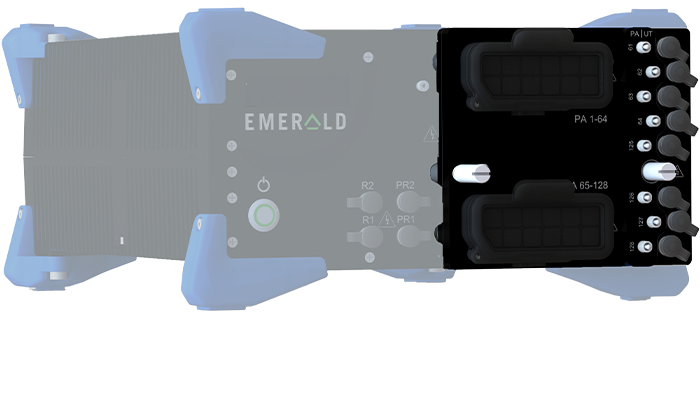
UltraVision manages inspection planning, acquisition, analysis and reporting, and connecting Emerald to a computer running UltraVision enables access to an advanced license. Multiple Emerald units can operate within one UltraVision session, with daisy-chained encoder and critical I/O signals simplifying integration. An accessory probe splitter supports two 64-element probes simultaneously and provides eight additional conventional UT channels.
Key capabilities
PAUT, TFM and TOFD
Combines phased array inspection, total focusing imaging and time-of-flight-diffraction in one industrial system.
Flexible acquisition
Supports FMC, PWI and Sparse firing modes, with FMC acquisition up to 128 elements.
Real-time multi-TFM
Processes up to eight simultaneous onboard TFM reconstructions, depending on frame size.
Sectorial total focusing
Reconstructs FMC or PWI data into a focused sectorial sweep with summed A-scans for each angle.
High-quality signals
Double-stage analog amplification and 16-bit digitizing enable high amplification without signal distortion.
Bipolar pulsers
Deliver up to 40% more acoustic energy at the same gain settings for penetration through thick components.
Industrial data transfer
Transfers inspection data over a five Gigabit per second Ethernet link with cables up to 100 meters (300 feet) long.
Multi-instrument scalability
Multiple Emerald units share one UltraVision session and can daisy-chain encoder and critical I/O signals.
Probe splitter flexibility
The accessory splitter connects two 64-element probes simultaneously and adds eight conventional UT channels.
UltraVision workflow
UltraVision supports acoustic beam simulation, technique development and validation, acquisition, analysis and reporting.
Published technical specifications
Values as published by Eddyfi Technologies. Where models or variants differ, each is listed separately.
INSTRUMENT
- Dimensions (W × H × D)
- 294 × 162 × 373 mm (11.5 × 6.4 × 14.7 in)
- Air Intake
- No
- Voltage
- 100 to 240 VAC
- Frequency
- 50 or 60 Hz
- Instrument Calibration
- Compliant with ISO 18563-1 / ISO 22232-1
ENVIRONMENT
- IP rating
- Designed for IP65
- Operating Temperature Range
- -10C to 45C (14F to 113F)
- Storage Temperature Range
- -40C to 70C (-40F to 158F)
PULSERS
- Channel configuration
- 64/128 PR
- Maximum applied voltage (50 Ω load)
- PA: 150Vpp (Bipolar) / 75V (Unipolar) UT: 200V
- Maximum PRF
- ≤ 30 kHz
- Max focal laws
- 2048
ACQUISITION
- Acquisition
- A-Scan/Peak/Conditional data recording
- Acquisition triggered on
- Free running, encoder position, external signal
- Digitizing range
- 800%
- Max data file size
- Limited by hard drive
FMC/TFM
- Maximum number of reconstruction channels
- 128
- Firing modes
- FMC, PWI, Sparse
- TFM frame size (on board)
- 1M points
- TFM frame size (off line)
- Unlimited
- Simultaneous FMC channels
- 2
- Maximum simultaneous TFM frames (on board)
- 2 (up to 1M points per frame) 8 (up to 256k points per frame)
I/O
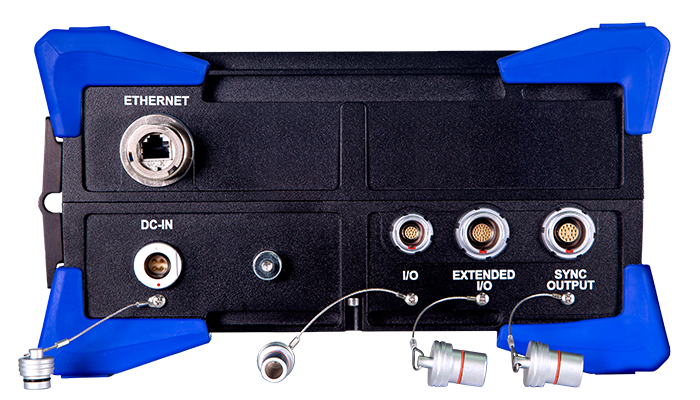
- PA connector
- 1x IPEX type (2x IPEX or 2x ZPAC with splitter module)
- UT connectors
- 4 x LEMO 00 (8 additional LEMO 00 with splitter module)
- Data connectivity
- Ethernet 5 GBit/second
- Encoder interfaces
- 3 quadrature-type
- I/O capability
- 12 inputs, 9 outputs
- Automated probe detection
- Yes (with Eddyfi Technologies' probe ID chip)
- Automated scanner detection
- Yes (with Eddyfi Technologies' probe ID chip)
- Daisy chaining
- I/O and encoder daisy chaining for multi-instrument configurations
RECEIVERS
- Gain
- Up to 124 dB (0.1 dB step), 76 dB Analog / 48 dB Digital
- Input impedance
- 50 Ω
- Bandwidth (-3 dB)
- PA: 0.5 to 18 MHz, UT: 0.5 to 22.5 MHz
- Data compression
- 1, 2, 4, 8, 16
- Amplitude resolution
- 14-bit elementary A-Scan, 16-bit PA
- Max number of samples
- 16k
- Max A-scan range
- 65k samples
- Measurement gates
- 6 + 1 synchronization gate (peak, crossing, auto-crossing, homing)
- Parallel PA channels processing
- Up to 2 channels
- Rectification
- Digital
- Filtering
- Analog / Digital (FIR)
- Digitizing frequency
- 100 MHz
- TCG dynamic range
- 40 dB
Performance details
- Full matrix capture (FMC)
- up to 128 elements
- PAUT
- 64 channel code compliant PAUT
- Onboard processing capability
- up to 1M+ points per TFM frame
- Raw FMC data recording
- up to 128-element apertures and two 64 element DMA (dual matrix array) probes
- Ethernet cable length
- up to 100 meters (300 feet) long
- Bipolar pulser acoustic energy
- up to 40% more acoustic energy for the same gain settings
- Dedicated UT channels
- Two dedicated UT channels
- Parallel aperture firing
- two parallel apertures up to 32 elements on any number of PAUT probes
Probe splitter accessory
- Simultaneous probe connections
- two 64-element probes simultaneously
- Additional channels
- Up to eight additional conventional channels or four TOFD pairs
- Connector availability
- IPEX and ZPAC connectors
- Dedicated probe splitter module, available with IPEX and ZPAC connectors
- UltraVision
- 64-element probes
- 64 element DMA (dual matrix array) probes
- Dedicated probe splitter module
- Operating Temperature Range: -10C to 45C (14F to 113F).
- Storage Temperature Range: -40C to 70C (-40F to 158F).
- Enclosure is described as designed for IP65.
- Onboard TFM supports two simultaneous frames at up to 1M points per frame or eight at up to 256k points per frame.
- Maximum data file size is limited by the hard drive.
- Automated probe and scanner detection require Eddyfi Technologies' probe ID chip.
- Additional conventional UT channels or TOFD pairs require the probe splitter module.
- Access to the UltraVision advanced license requires Emerald to be connected to a computer with UltraVision.
Compatibility lists only items named by Eddyfi for this product; confirm configuration with EMUS before ordering.
Typical applications
- Oil and gas inspection
- Power generation inspection
- In-service railway inspection
- Manufacturing inspection
- Heavy industry inspection
- Aerospace inspection
- Thick-component inspection
- Complex, multi-probe high-speed inspection
Product imagery
Product videos
Official brochures
How EMUS supports this
Equipment is only part of the answer. Every system we supply is backed by regional engineering, service and application support.
Mechanical, electrical, environmental setup done right the first time.
Qualification and acceptance testing against real criteria.
Operator and application training built around your parts.
Traceable calibration to keep measurements audit-ready.
Preventive and corrective service across the Balkan region.
Method development and problem-solving with our engineers.
Eddyfi Technologies
Part of the Eddyfi Technologies portfolio, represented by EMUS across the Balkan region.
Application Notes & resources
Official application notes and technical literature for Emerald.
Request an Engineering Consultation
Talk to an EMUS engineer about this product and whether it fits your inspection workflow.