
Panther 2
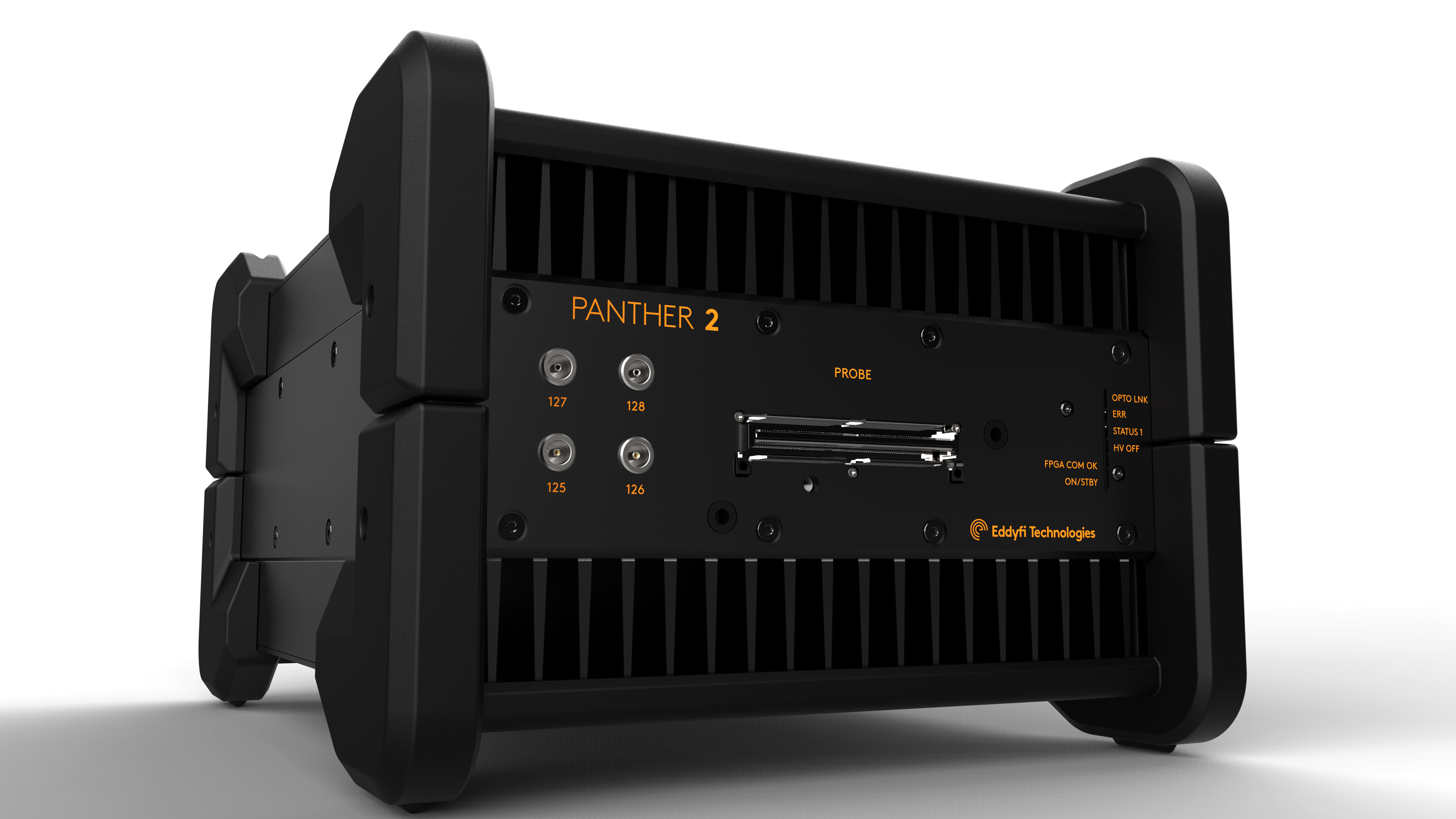
Panther 2 is a scalable industrial PAUT instrument with TFM capabilities, high-speed data transfer and software tools for automated inspection and NDT development.
Product overview
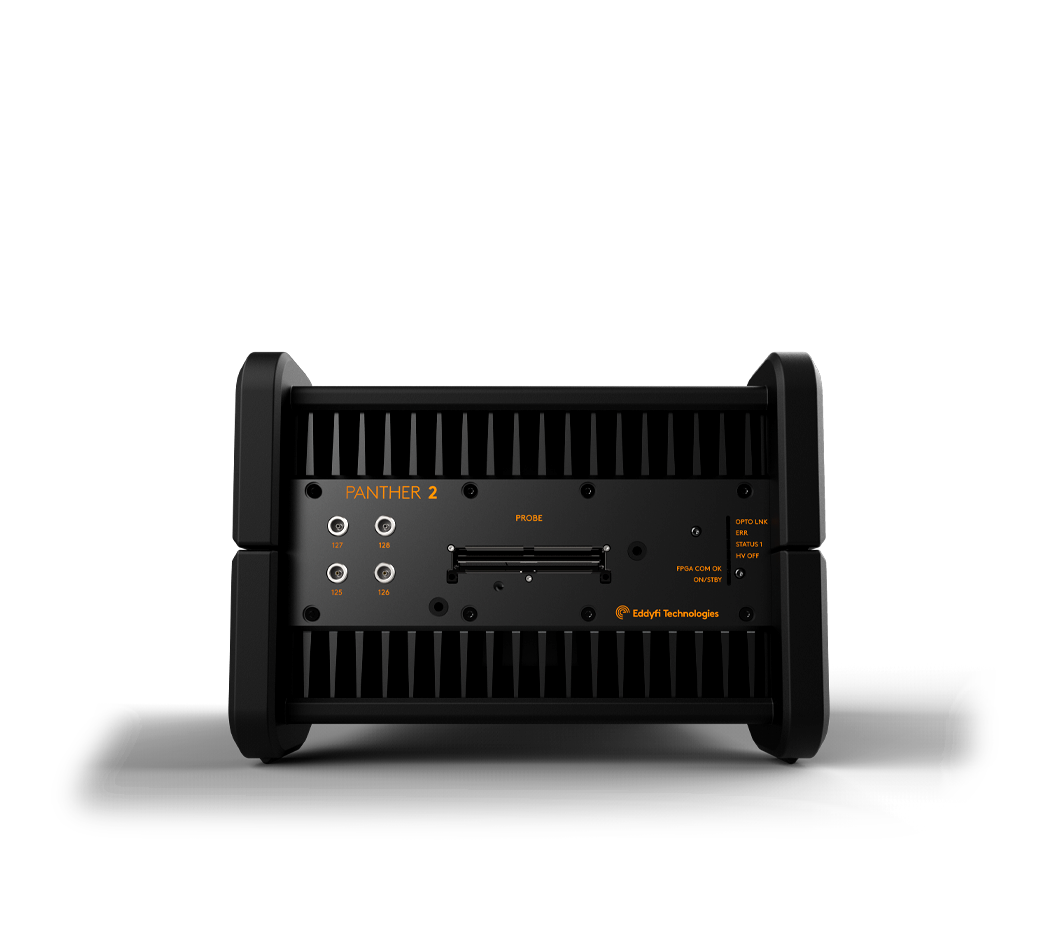
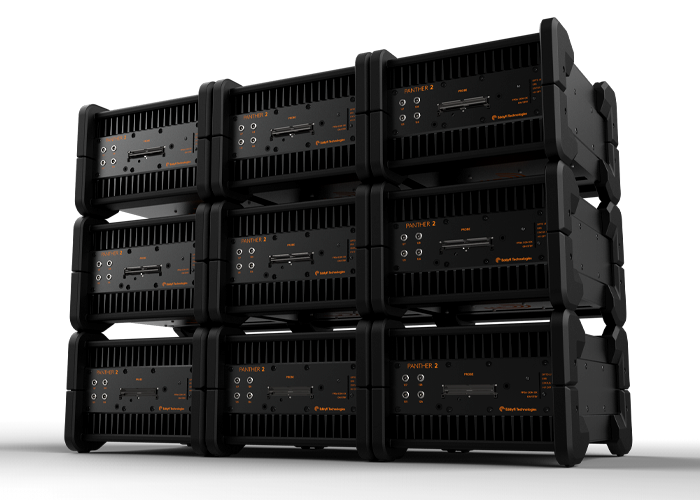
Panther 2 is a phased array ultrasonic testing instrument designed for integrators, manufacturers, industrial laboratories and NDT service providers. Its industrial design combines protective bumpers, stackability and automation capabilities for inspection work in aerospace, oil and gas, and metallurgy.
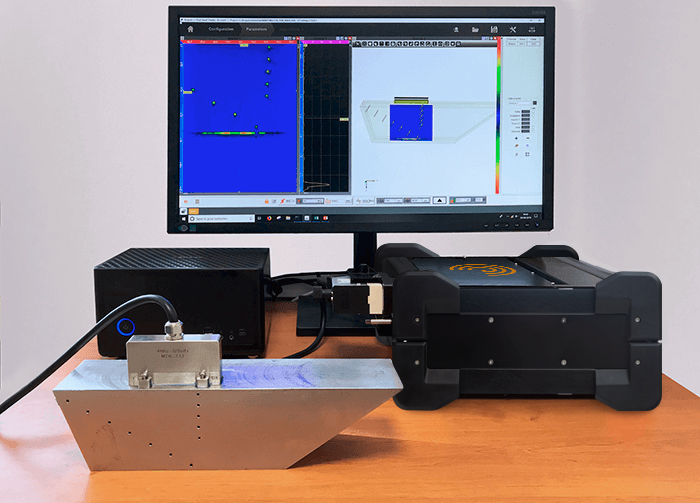
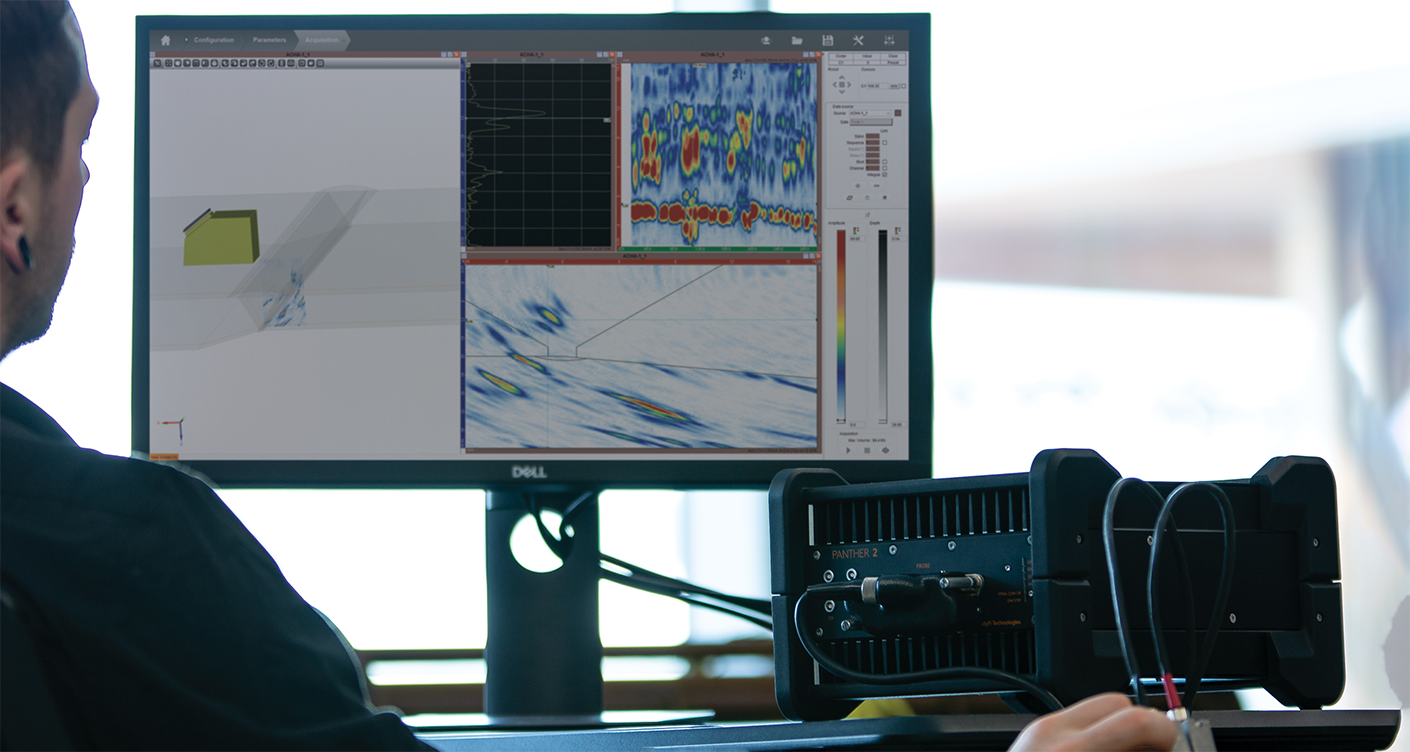
The platform combines PAUT with a TFM toolbox through Acquire acquisition software. Supported techniques include full matrix capture and plane wave imaging, with customizable propagation modes, image fusion and reconstruction settings. Elementary A-scans and CIVA simulation tools are accessible for developing and evaluating inspection methods.
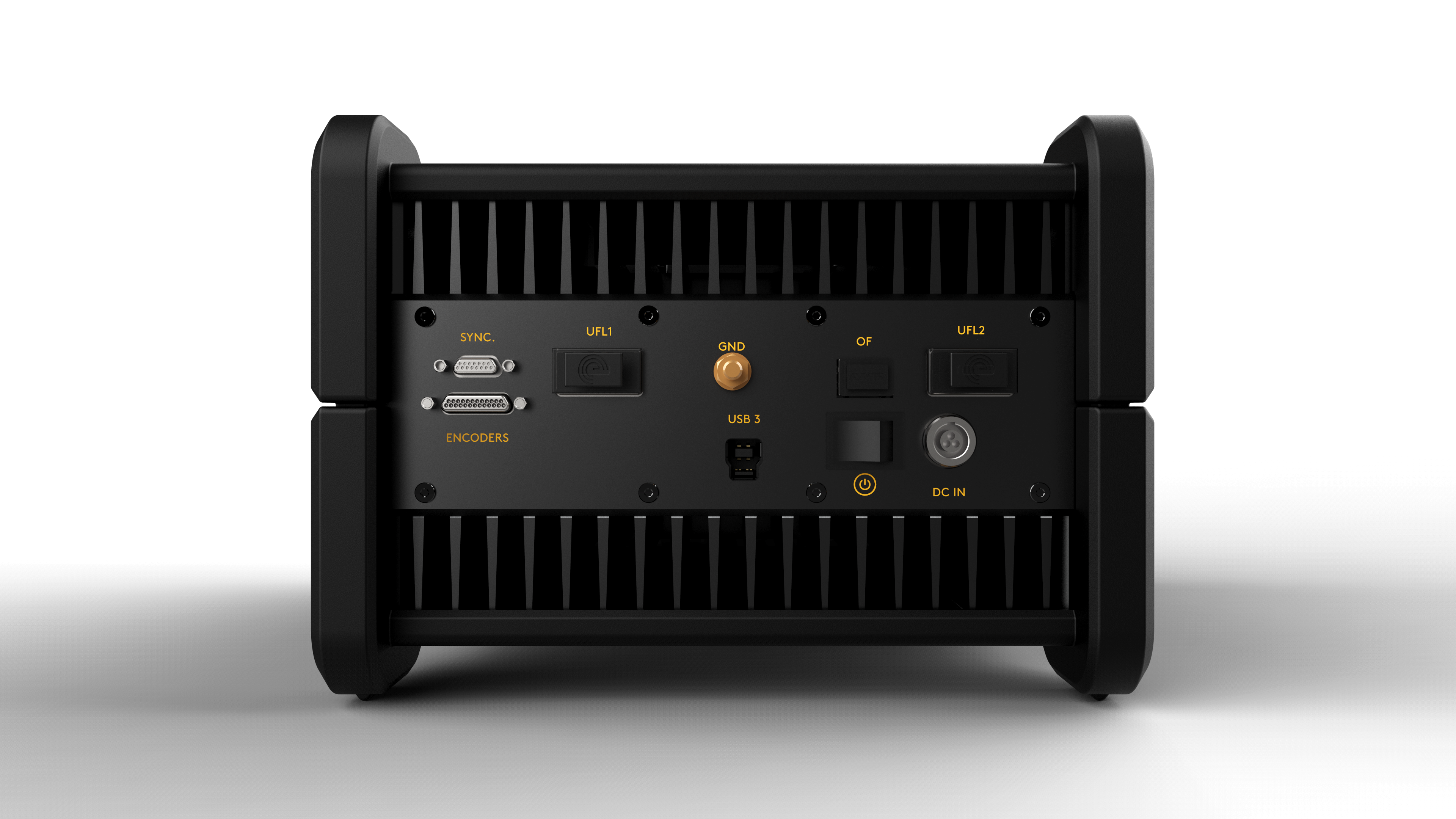
Configurations extend from 32 up to 2,048 elements, with up to 16 units connected in parallel and a 256-element active aperture. A 320MB/s link supports data transfer over USB3 cables up to 5 meters (16 feet), or RJ45 cables up to 30 meters (98 feet) when used with a USB to ethernet hub.
For customized automated systems, the high-level SDK provides control of acquisition parameters and access to real-time conventional ultrasonic, PAUT and TFM data, as well as saved data for post-processing. Acquire also supports component geometry imports and multiple PAUT probe types for industrial inspection, laboratory work and research.
Key capabilities
Industrial construction
Reinforced bumpers protect the instrument and allow convenient stacking.
High-speed data transfer
A 320MB/s link transfers inspection data through USB3 or RJ45 connections.
Flash inspection modes
Exclusive flash modes are designed to increase inspection productivity.
Scalable architecture
Up to 16 units can operate in parallel, with configurations extending to 2,048 elements.
Customizable TFM
Acquire supports FMC, PWI pitch/catch, image fusion, tailored propagation modes and adaptive reconstruction.
Flexible probe support
Acquire works with most PAUT probe types, including matrix, sparse array, daisy, DLA and DMA probes.
Open development tools
The OS- and language-independent SDK exposes acquisition parameters and real-time or saved inspection data.
Geometry and simulation tools
Acquire supports 2D and 3D component imports and a PAUT/TFM toolbox powered by CIVA simulation software.
Published technical specifications
Values as published by Eddyfi Technologies. Where models or variants differ, each is listed separately.
INSTRUMENT
- Dimensions (W × H × D)
- 298 × 220 × 159 mm (11.7 × 8.7 × 6.3 in)
- Weight
- 6 kg (13.2 lbs)
- Operating Temperature
- -10-50°C (14-120°F)
- Storage Temperature
- -10-60°C (14-140°F)
- IP Rating
- IP20 (IP54 with accessory)
- Power Supply
- 110–240 VAC, 50–60 Hz
- Configurations
- 32:128PR, 64:64PR, 64:128PR, 256:256PR with or without TFM
PULSERS
- Phased Array Channels
- 128 Phased Array Channels*
- Bipolar Square Pulse Width
- 30 ns to 2,000 ns
- Voltage Amplitude
- Maximum 100 V with 1 V step
- Maximum PRF
- Up to 30 kHz
RECEIVERS
- Phased Array Channels
- 128 Phased Array Channels*
- Input Impedance
- 50 Ω
- Frequency Range
- 0.4-20 MHz
- Maximum Input Signal
- 1.8 Vpp
- Gain
- Up to 120 dB (0.1 dB step)
- Crosstalk Between Two Channels
- < 50 dB
- Analog Amplifier
- Ultralow noise amplifier
ACQUISITION
- A-scan/Peak Data Recording
- 800% amplitude range
- Inspection Data File Size
- Hard drive limit
- Acquisition Triggers
- Time, event, encoder
- Data Transfer
- USB3 or RJ45 cable
ANALYSIS
- Views
- A-scan, B-scan, C-scan, D-scan, echodynamic, top, side, front, 3D
- FMC/PWI Data Acquisition Post-Process TFM Reconstruction
- CAD geometry with CIVA™**
- Software Compatibility
- Capture, CIVA and ULTIS™**
- Amplitude Range
- Up to 800%
Fastest Data Throughput
- High-speed link
- 320MB/s
- USB3 cable distance
- up to 5 meters (16 feet) with USB3 cable
- RJ45 cable distance
- up to 30 meters (98 feet) with RJ45 cable and USB to ethernet hub
Ready, Set... Done!
- Flash mode speed claim
- 10+ times faster than any other commercially available phased array test instrument
Scalability
- Channel scalability
- up to 2,048 channels
- Element configurations
- from 32 up to 2,048 elements
- Parallel units
- up to 16 units in parallel
- Active aperture
- 256-element active aperture
- Probe Number Limit
- None.
- Accessory for IP54 protection
- Acquire
- Capture
- CIVA
- ULTIS
- Matrix PAUT probes
- Sparse array PAUT probes
- Daisy PAUT probes
- Dual linear array (DLA) probes
- Dual matrix array (DMA) probes
- Operating temperature: -10-50°C (14-120°F).
- Storage temperature: -10-60°C (14-140°F).
- IP20 protection; IP54 requires an accessory.
- USB3 cable distance is up to 5 meters (16 feet); distances up to 30 meters (98 feet) require an RJ45 cable and USB to ethernet hub.
- Inspection data file size is limited by the hard drive.
- Configurations are offered with or without TFM.
Compatibility lists only items named by Eddyfi for this product; confirm configuration with EMUS before ordering.
Typical applications
- Automated industrial NDT
- Laboratory inspection and NDT research
- Aerospace inspection
- Oil and gas inspection
- Metallurgy inspection
- Phased array weld inspection
- Welding defect inspection
- Phased array corrosion mapping
- Pipe body inspection
Product imagery
Product videos
Official brochures
Weld Inspection Paparazzi | World Pipelines Article
Panther 2 User Manual
How EMUS supports this
Equipment is only part of the answer. Every system we supply is backed by regional engineering, service and application support.
Mechanical, electrical, environmental setup done right the first time.
Qualification and acceptance testing against real criteria.
Operator and application training built around your parts.
Traceable calibration to keep measurements audit-ready.
Preventive and corrective service across the Balkan region.
Method development and problem-solving with our engineers.
Eddyfi Technologies
Part of the Eddyfi Technologies portfolio, represented by EMUS across the Balkan region.
Application Notes & resources
Official application notes and technical literature for Panther 2.
Request an Engineering Consultation
Talk to an EMUS engineer about this product and whether it fits your inspection workflow.