MIZ-21C
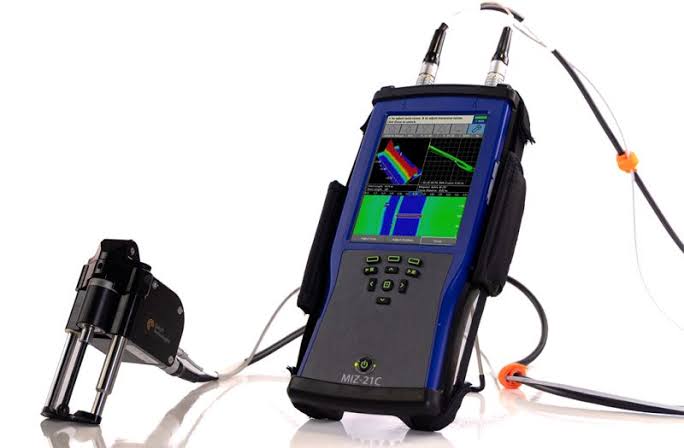
MIZ-21C is a handheld eddy current instrument with optional surface array inspection, axial bolt-hole encoding, and conductivity and coating thickness measurement capabilities.
Product overview
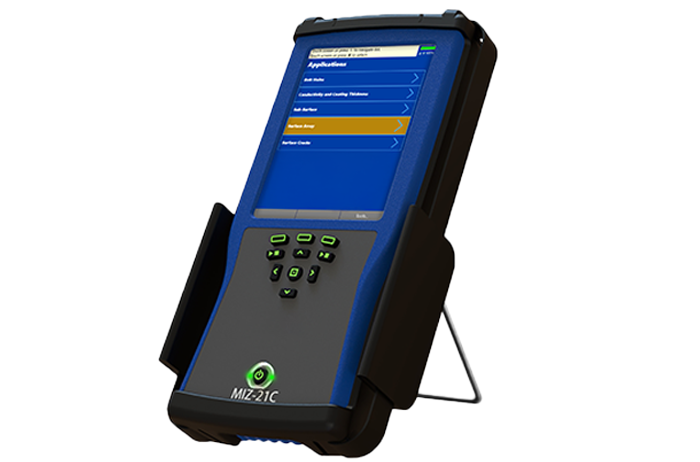
MIZ-21C is a portable eddy current testing instrument intended for aerospace and other surface inspection applications. Its touchscreen, embedded software and ergonomic housing support one-handed operation, while battery life of up to 10 hours supports extended inspection work. The surface array option can reduce inspection time by up to 95% compared with pencil probes and is presented as an alternative to liquid penetrant and magnetic particle inspections.
For cracks near fastener holes, operators can calibrate the signal display against a known crack or notch standard, then estimate surface crack depth and length by comparing signal phase and amplitude. The Surf-X Array probe provides an alternative surface array approach for faster coverage. Signal-to-noise filtering helps isolate flaw indications, while dual-frequency mixing nearly eliminates unwanted signals associated with varying air gaps during multi-layer corrosion inspection.
Bolt-hole inspection with an axial encoder adds speed-independent, multi-layer scanning to rotating-probe inspection. This enables flaw location by layer and measurement of layer delamination. Dedicated conductivity probes also allow characterization and sorting of metals and alloys, and the instrument can measure nonconductive coating thickness.
Key capabilities
Handheld surface array
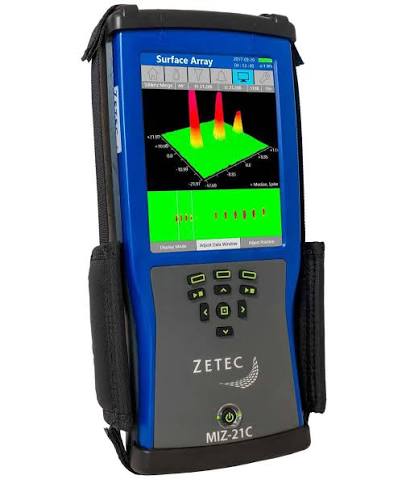
Optional surface array inspection can reduce inspection time by up to 95% versus pencil probes.
Portable ergonomic design
A weight of 1.2 kg (2.6 lb), including batteries and cover, supports one-handed operation.
Extended battery operation
Battery life reaches up to 10 hours.
Touchscreen interface
A multi-touch display and embedded software support quick setup and inspection.
Axial bolt-hole encoding
The accessory axial encoder supports speed-independent multi-layer scans for flaw location and delamination measurement.
Signal-to-noise filtering
The SNR filter helps inspectors isolate target flaw signals.
Dual-frequency mixing
Dual-frequency mixing nearly eliminates unwanted air-gap signals in multi-layer corrosion inspections.
3D C-scan visualization
The instrument provides 3D C-scan data visualization.
Flexible connectivity
USB 2.0, Wi-Fi and Bluetooth provide connectivity options.
Conductivity and coating measurements
Dedicated conductivity probes support material characterization, while nonconductive coating thickness can also be measured.
Published technical specifications
Values as published by Eddyfi Technologies. Where models or variants differ, each is listed separately.
General
- Dimensions (H × W × D)
- 267 × 122 × 38 mm (10.5 × 4.8 × 1.5 in)
- Weight (including batteries and cover)
- 1.2 kg (2.6 lb)
- Multi-Touch Display
- 5.7 in (480 x 640 pixels)
- Battery Life
- Up to 10 hours
Inspection performance
- Surface array inspection time reduction versus pencil probes
- up to 95%
Connections and encoding
- Eddy Current Connector
- 18-Pin Lemo
- Eddy Current Array Connector
- 26-Pin Lemo
- Connectivity
- USB 2.0, Wi-Fi, Bluetooth
- Encoders
- 2 axes, Quadrature, Only 1 axis is currently available for surface array applications
- Probe Recognition and Setup
- Automatic with Zetec ID Chip
MIZ-21C-SF
- Coil Inputs
- 1
- Frequencies Per Timeslot
- 1
- Data Channels
- 32
- Maximum Probe Coils
- 2
- Rotating Scanner
- No
MIZ-21C (as labeled in specifications)
- Coil Inputs
- 1
- Frequencies Per Timeslot
- 2
- Data Channels
- 64
- Maximum Probe Coils
- 2
- Rotating Scanner
- Yes
MIZ-21C-ARRAY
- Coil Inputs
- 3
- Frequencies Per Timeslot
- 2
- Data Channels
- 192
- Maximum Probe Coils
- 32
- Rotating Scanner
- Yes
Eddy current
- Frequency Range
- 5 Hz to 10 MHz
- Generator Output
- Up to 12 Vpp (19 Vpp for ECA) in 0.1 Volt increments
- Injection Modes
- Continuous and Super-Multiplex
- Receiver Gain
- 10 to 173 dB
- Data Resolution
- 16 bits
- Probe Drive
- 50 Ohm
- Filters
- Median, High Pass, Low Pass, High Pass 2 (Adjustable CC), Bandpass, Spike, SNR
- Alarms
- Adjustable Box, Sector, and Polar, Audio adjustable volume, Headphone support
Conductivity and coating thickness
- Conductivity Frequency
- 60, 120, 240 and 480 kHz
- Conductivity Specification
- Digital readout in 0.9 to 110 %IACS (0.5 to 70 MS/m), Accuracy within ±0.5% IACS from 0.9% to 65% IACS and within ±1.0% of values over 65%
- Non-Conductive Coating Thickness
- Can measure non-conductive coating thickness from 0 mm (0 mil) to 2.032 mm (80 mil). Accuracy of 0.025 mm (±0.001 in.) over a 0 mm to 0.64 mm range
Accessories
- Axial Encoder (Accessory)
- Determines depth, length, and location of flaws
Data and software
- Maximum Data File Size
- 60 s or 10 meters
- Languages
- English, Spanish, French, German, Chinese, Japanese, Portuguese, Russian
- Storage
- 128 GB
Calibration
- Instrument Calibration
- Compliant with ISO/IEC 17025:2005, Meets or exceeds manufacturer's requirements
Power
- Voltage
- 100 to 240 VAC, Auto-Switching
- Frequency
- 50 to 60 Hz
- Output Voltage
- 15 VDC
- Maximum Power
- 40 W
Environment
- Operating Temperature
- -10°C to 50°C (14°F to 122°F)
- Storage Temperature
- -20°C to 70°C (-4°F to 158°F) (w/out batteries)
- Relative Humidity
- 95% non-condensing
- Surface array option
- Axial encoder accessory
- Pencil probes
- Surf-X Array probe
- Surf-X Array probe
- Zetec Rotating Scanner
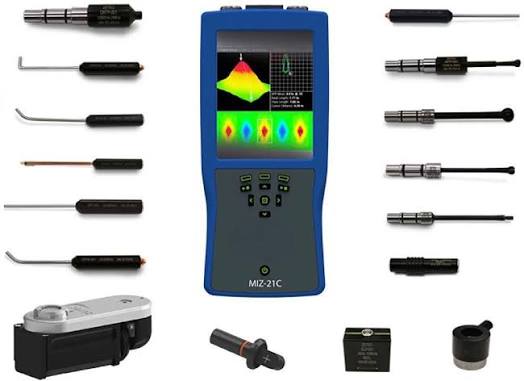
- Standard rotating probes with the axial-encoder module
- Pencil probes
- Dedicated conductivity probes
- Probes with Zetec ID Chip for automatic recognition and setup
- Only 1 encoder axis is currently available for surface array applications.
- MIZ-21C-SF does not support a rotating scanner.
- Maximum data file size: 60 s or 10 meters.
- Operating temperature: -10°C to 50°C (14°F to 122°F).
- Storage temperature: -20°C to 70°C (-4°F to 158°F), without batteries.
- Relative humidity: 95% non-condensing.
- The up to 95% inspection time reduction applies to the surface array option compared with pencil probes.
- Surface crack depth and length estimates using pencil probes rely on comparison with a known crack or notch standard.
- The model overview names MIZ-21C-DF, but the corresponding model-specific entries in the specifications are labeled MIZ-21C; the page does not explicitly resolve this naming difference.
Compatibility lists only items named by Eddyfi for this product; confirm configuration with EMUS before ordering.
Typical applications
- Aerospace inspection
- Axially encoded bolt-hole inspection
- Multi-layer airframe corrosion inspection
- Surface crack detection near fastener holes
- Layer delamination measurement
- Conductivity-based material characterization and sorting
- Nonconductive coating thickness measurement
- Alternative to liquid penetrant and magnetic particle inspections
Product imagery
Product videos
Official brochures
MIZ-21C — Product Brochure
MIZ-21C — Product BrochureMIZ-21C User Manual
MIZ-21C Probe and Accessory Guide
MIZ-21C Quick Start Guide
Alternatives from other manufacturers
Comparable systems we also represent. If your application requires a different balance of speed, resolution or footprint, these are worth reviewing.
Structure & Hardness Test Instruments
ibg's family of digital eddy-current instruments for 100% comparative verification of heat treatment, hardness, case depth and material mix-ups on mass-produced steel parts.
Compareibg NDT TechnologyeddyQlab Ai
Laboratory system that uses eddy-current data and a pre-trained AI model to predict case depth and surface hardness of induction-hardened parts such as CV joints.
Compareibg NDT TechnologyeddyQlab Ai VL
Semi-automated, one-button lab system for CV joints that predicts surface hardness and case depth non-destructively using AI and machine learning.
Compareibg NDT Technologyeddyguard neo S
Next-generation eddy-current controller for microstructure testing, built for easy machine integration, Industrial Ethernet connectivity and multi-device control.
CompareHow EMUS supports this
Equipment is only part of the answer. Every system we supply is backed by regional engineering, service and application support.
Mechanical, electrical, environmental setup done right the first time.
Qualification and acceptance testing against real criteria.
Operator and application training built around your parts.
Traceable calibration to keep measurements audit-ready.
Preventive and corrective service across the Balkan region.
Method development and problem-solving with our engineers.
Eddyfi Technologies
Part of the Eddyfi Technologies portfolio, represented by EMUS across the Balkan region.
Application Notes & resources
1 application note and related technical literature for MIZ-21C.
Surface Crack Detection with Eddy Current
Conventional eddy current crack detection.
Bolt-Hole Inspection
Rotating-probe bolt-hole crack inspection.
Conductivity & Coating Thickness
Material sorting and coating measurement.
Request an Engineering Consultation
Talk to an EMUS engineer about this product and whether it fits your inspection workflow.