
eddyQlab Ai
Model: eddyQlab Ai
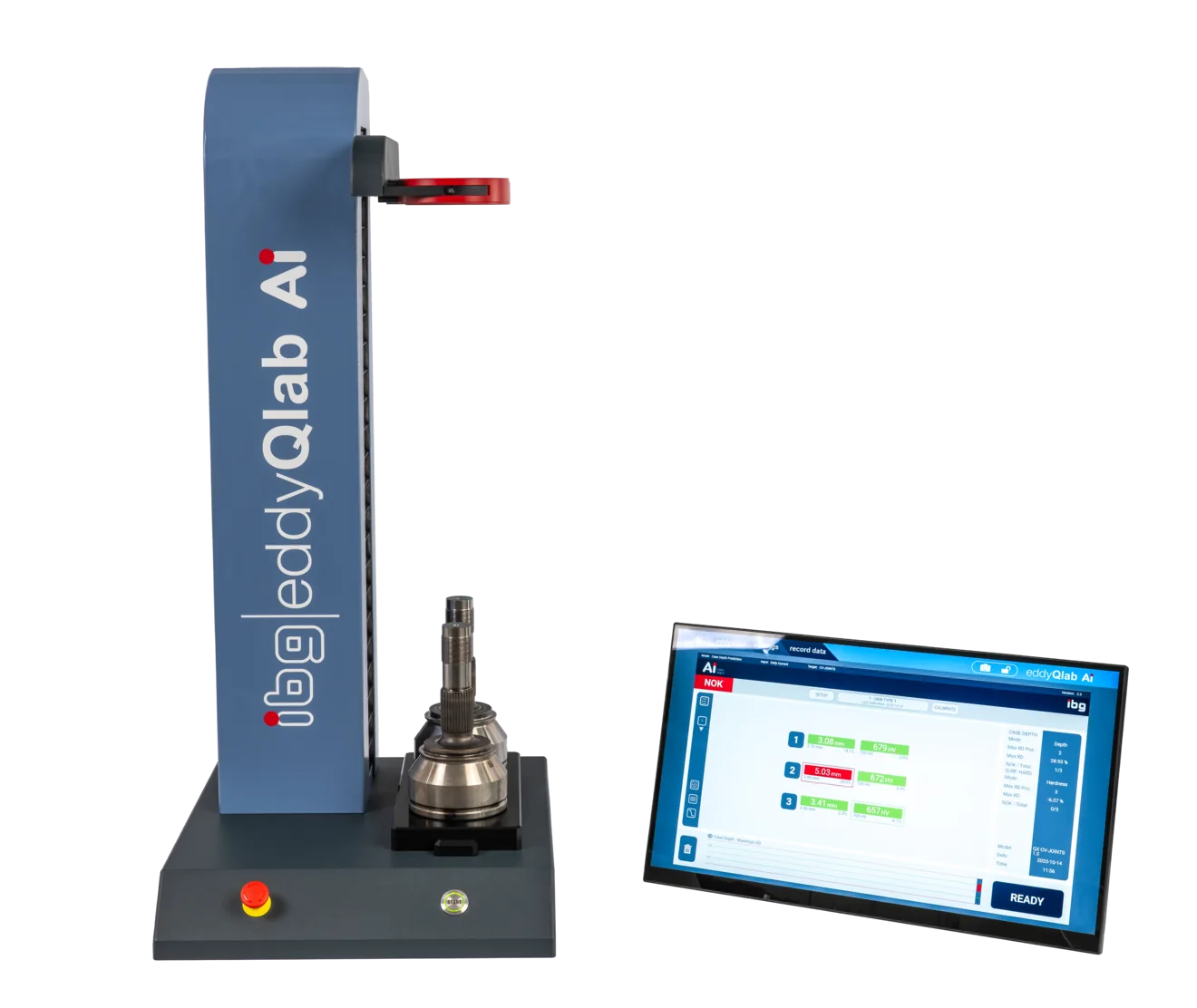
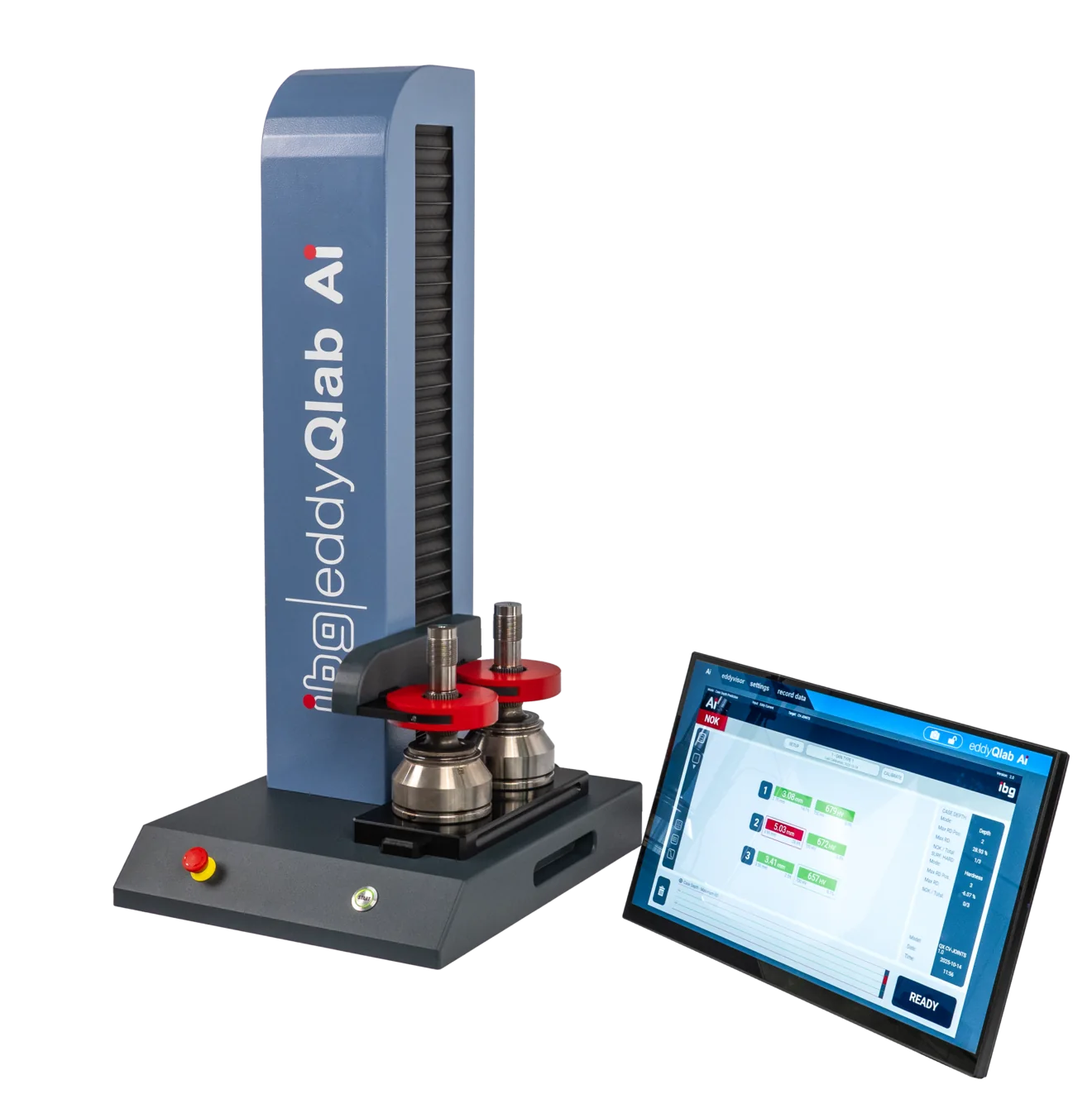
Laboratory system that uses eddy-current data and a pre-trained AI model to predict case depth and surface hardness of induction-hardened parts such as CV joints.
About the eddyQlab Ai
The eddyQlab Ai brings ibg's AI-based evaluation into the laboratory. Eddy-current signals from the induction-hardened zone are evaluated by a pre-trained model that is locked for a defined part and process, and the system predicts surface hardness and case depth at the configured test positions in under a minute per part, according to ibg.
ibg describes the result as a prediction, not a direct measurement. The model is set up for each part type using reference parts, and destructive testing remains the basis against which the model is established; the system is positioned to reduce, not eliminate, destructive cuts.
For CV joints, ibg offers the dedicated eddyQlab Ai VL variant described on its own page.
- Monitor(recommended resolution: 1920 x 1080 px)
Where the eddyQlab Ai is used
- Case-depth and surface-hardness prediction on induction-hardened parts
- CV joint laboratory testing
- Reducing destructive cut-and-etch sampling
- Batch release and process monitoring of induction hardening
Questions answered by ibg
What is the difference between testing and predicting case depth and surface hardness?
The software of the eddyQlab Ai VL goes a step further than just testing induction-hardened parts, it provides a numeric prediction of the case depth and surface hardness without the need to destroy parts.
What is required for the setup of the eddyQlab Ai?
For best results, please send two sets of 15 CV joints from the same batch to the Application Lab in Ebermannstadt. Our experts will conduct a feasibility study on these samples. After a successful feasibility study, our sales partners will contact you for further proceedings. If the feasibility study has not been sufficient, further Ai Training is needed. For this, send five sets of 15 CV joints of the same batch to the Application Lab in Ebermannstadt. Afterwards, you are again contacted by our Sales Partners. Does the Ai recognize circumferential differences in the case depth or the surface hardness? No, only in case these differences would be large and influential. Eddy current testing inherently provides results that represent the entire volume of material within the signal-taking coil. The magnetic flux density uniformly permeates the test area in all directions. As a result, any variations in microstructure distributed across the diameter are effectively averaged in the eddy current response, resulting in a stable and consistent signal.
Do I need any additional equipment for doing tests on the eddyQlab Ai?
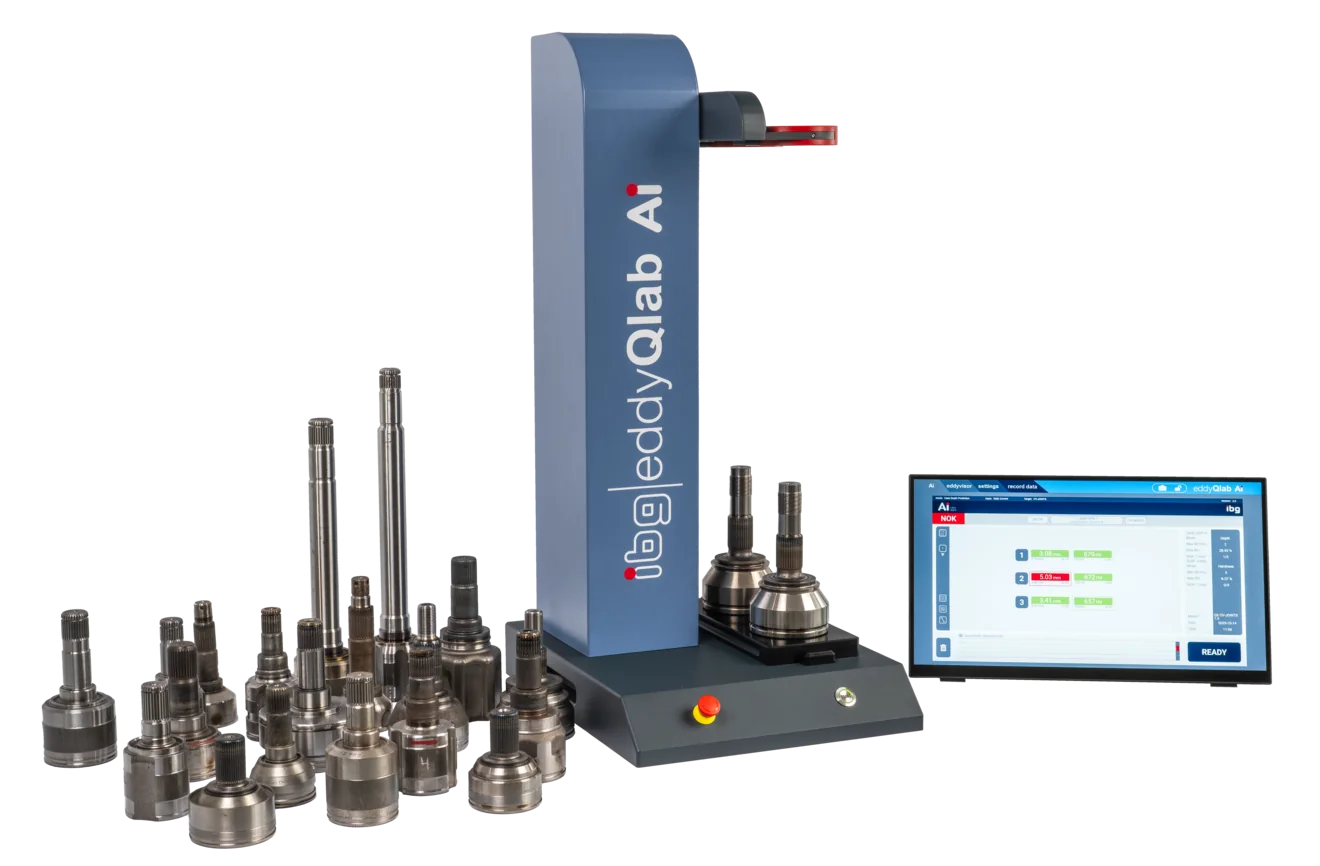
Apart from the equipment provided by ibg (Test Unit, Control Unit, Cable, and Base Plate), customers will also need to supply the following:
Do I need to perform (additional) hardness testing?
Yes, you would still need to perform standardized (destructive) hardness testing methods, as those are standardized. Nevertheless, these would have to be performed significantly less, e.g. when new parts are settled, when the heat treatment part for already registered parts has been changed or when the steel type of parts has been changed.
Is there any preparation needed for parts tested with the eddyQlab Ai?
The eddyQlab Ai does not require any sample preparation. There will also be no waste, as neither the parts are destroyed nor any chemicals are involved.
Do I need any knowledge on eddy current to use the eddyQlab Ai?
No, you do not need any knowledge on eddy current, as the results are directly displayed in Vickers or Rockwell in the HMI.
Product imagery
Brochures, datasheets & catalogues
Whitepaper: AI prediction vs. destructive microhardness profile testing
PDF · Whitepaper
Alternatives from other manufacturers
Comparable systems we also represent. If your application requires a different balance of speed, resolution or footprint, these are worth reviewing.
MIZ-21C
MIZ-21C is the most advanced handheld eddy current instrument with surface array capability, simplifying inspection confidence for aerospace, oil & gas, manufacturing and power generation.
CompareEddyfi TechnologiesReddy
Reddy is the first portable, battery-operated system for eddy current array, eddy current tubing and MFL inspection — combining on-site acquisition, real-time C-scan imaging and one-click reporting in a rugged, sealed instrument.
CompareEddyfi TechnologiesLyft
Lyft is Eddyfi's dedicated Pulsed Eddy Current platform for corrosion assessment through insulation, fireproofing and weather jackets. The platform combines PEC and PECA technologies with SmartPULSE automation, Tau-scan analysis and real-time C-scan imaging.
CompareEddyfi TechnologiesAmigo 2
With more than three decades of proven field performance, ACFM technology has become the industry benchmark for in-service weld inspection. Amigo2 extends this legacy with increased portability, improved signal quality, enhanced productivity and modern connectivity. The platform supports conventional probes, Sensu2 array probes, underwater probes and high-temperature applications, combining hardware, Assist software and Sensu probe technologies into a complete ACFM inspection ecosystem.
CompareHow EMUS supports this
Equipment is only part of the answer. Every system we supply is backed by regional engineering, service and application support.
Mechanical, electrical, environmental setup done right the first time.
Qualification and acceptance testing against real criteria.
Operator and application training built around your parts.
Traceable calibration to keep measurements audit-ready.
Preventive and corrective service across the Balkan region.
Method development and problem-solving with our engineers.
ibg NDT Technology
TheeddyQlab Ai is part of the ibg NDT Technology portfolio, supplied and supported by EMUS across the Balkan region.
Request Technical Consultation
Talk to an EMUS engineer about theeddyQlab Ai, your parts and tolerances, and the configuration that fits your inspection workflow.