Pulsed Eddy Current Probe for Galvanized Steel Cladding
The PEC-GS probe detects corrosion under insulation through galvanized steel weather jackets using pulsed eddy current inspection with enhanced signal penetration.
Product overview
The PEC-GS is a pulsed eddy current probe designed for corrosion under insulation inspection on structures protected by galvanized steel weather jackets. Used with Lyft, it addresses the inspection challenges posed by ferromagnetic cladding.
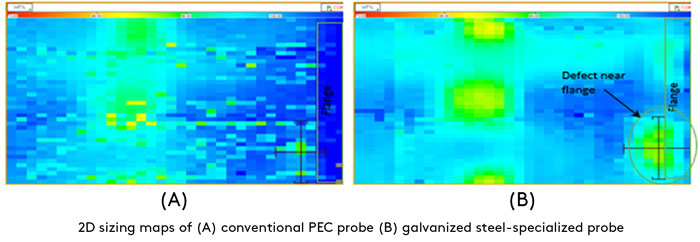
Its patent-pending design improves PEC signal penetration and signal-to-noise ratio through galvanized steel, supporting corrosion detection and sizing beneath insulation. The stated inspection envelope includes metal thicknesses up to 38 mm (1.5 in), insulation thicknesses of 13–152 mm (0.5–6.0 in), and galvanized steel jackets up to 1 mm (0.04 in) thick.
Applications include insulated structures and pipes with diameters as small as 25 mm (1 in), as well as detection of corrosion and erosion beneath paint, coatings, and insulation. The probe operates in grid scanning mode without an encoder; a separately sold 15 m/50 ft extension cable supports rope-access work.
Key capabilities
Galvanized jacket inspection
Designed specifically to detect corrosion under insulation through galvanized steel weather jackets up to 1 mm (0.04 in) thick.
Improved signal performance
The patent-pending probe design improves signal penetration and enhances signal-to-noise ratio.
Detection and sizing
The probe is designed to maintain detection capability and sizing accuracy in the presence of ferromagnetic galvanized cladding.
Wall thickness coverage
Supports inspection of metal thicknesses up to 38 mm (1.5 in).
Insulation coverage
Supports insulation/coating liftoff of 13–152 mm (0.5–6.0 in).
Small-diameter pipes
Can scan pipes with diameters as small as 25 mm (1 in).
Rope-access extension
A separately sold 15 m/50 ft extension cable supports rope-access inspection.
Published technical specifications
Values as published by Eddyfi Technologies. Where models or variants differ, each is listed separately.
GENERAL
- Casing
- Medium
- Wall thickness
- Up to 38 mm (1.5 in)
- Insulation/coating thicknesses (liftoff)
- 13–152 mm (0.5–6.0 in)
- Footprint at minimum liftoff
- 62 mm (2.44 in)
- Encoder
- None. Grid scanning mode only.
- Cable
- 5 m (16.4 ft)
- Maximum surface temperature
- Direct contact operation: 70°C (158°F)
Inspection capabilities
- Maximum galvanized steel weather jacket thickness
- 1 mm (0.04 in)
- Minimum pipe diameter
- 25 mm (1 in)
Features
- Insulation thickness
- 13–152 mm (0.5–6 in)
Accessories
- Extension cable length (sold separately)
- 15 m/50 ft
- 15 m/50 ft extension cable for rope access, sold separately
- Lyft
- No encoder; grid scanning mode only.
- Maximum metal wall thickness: 38 mm (1.5 in).
- Insulation/coating liftoff range: 13–152 mm (0.5–6.0 in).
- Maximum galvanized steel weather jacket thickness: 1 mm (0.04 in).
- Minimum pipe diameter: 25 mm (1 in).
- Maximum surface temperature for direct contact operation: 70°C (158°F).
Compatibility lists only items named by Eddyfi for this product; confirm configuration with EMUS before ordering.
Typical applications
- Corrosion under insulation beneath galvanized steel weather jackets
- Inspection of insulated structures
- Insulated pipe inspection
- Corrosion and erosion detection beneath paint, coatings, and insulation
- Rope-access inspection
Product videos
Official brochures
Understanding Lyft PEC probe selection and footprint
Alternatives from other manufacturers
Comparable systems we also represent. If your application requires a different balance of speed, resolution or footprint, these are worth reviewing.
Structure & Hardness Test Instruments
ibg's family of digital eddy-current instruments for 100% comparative verification of heat treatment, hardness, case depth and material mix-ups on mass-produced steel parts.
Compareibg NDT TechnologyeddyQlab Ai
Laboratory system that uses eddy-current data and a pre-trained AI model to predict case depth and surface hardness of induction-hardened parts such as CV joints.
Compareibg NDT TechnologyeddyQlab Ai VL
Semi-automated, one-button lab system for CV joints that predicts surface hardness and case depth non-destructively using AI and machine learning.
Compareibg NDT Technologyeddyguard neo S
Next-generation eddy-current controller for microstructure testing, built for easy machine integration, Industrial Ethernet connectivity and multi-device control.
CompareHow EMUS supports this
Equipment is only part of the answer. Every system we supply is backed by regional engineering, service and application support.
Mechanical, electrical, environmental setup done right the first time.
Qualification and acceptance testing against real criteria.
Operator and application training built around your parts.
Traceable calibration to keep measurements audit-ready.
Preventive and corrective service across the Balkan region.
Method development and problem-solving with our engineers.
Eddyfi Technologies
Part of the Eddyfi Technologies portfolio, represented by EMUS across the Balkan region.
Application Notes & resources
Official application notes and technical literature for Pulsed Eddy Current Probe for Galvanized Steel Cladding.
Request an Engineering Consultation
Talk to an EMUS engineer about this product and whether it fits your inspection workflow.