
Remote-Field Array (RFA) Probe
Remote-field array probes deliver high-resolution C-scans of ferrous heat exchanger tubes at conventional RFT speeds, with improved detection near support plates and tubesheets.
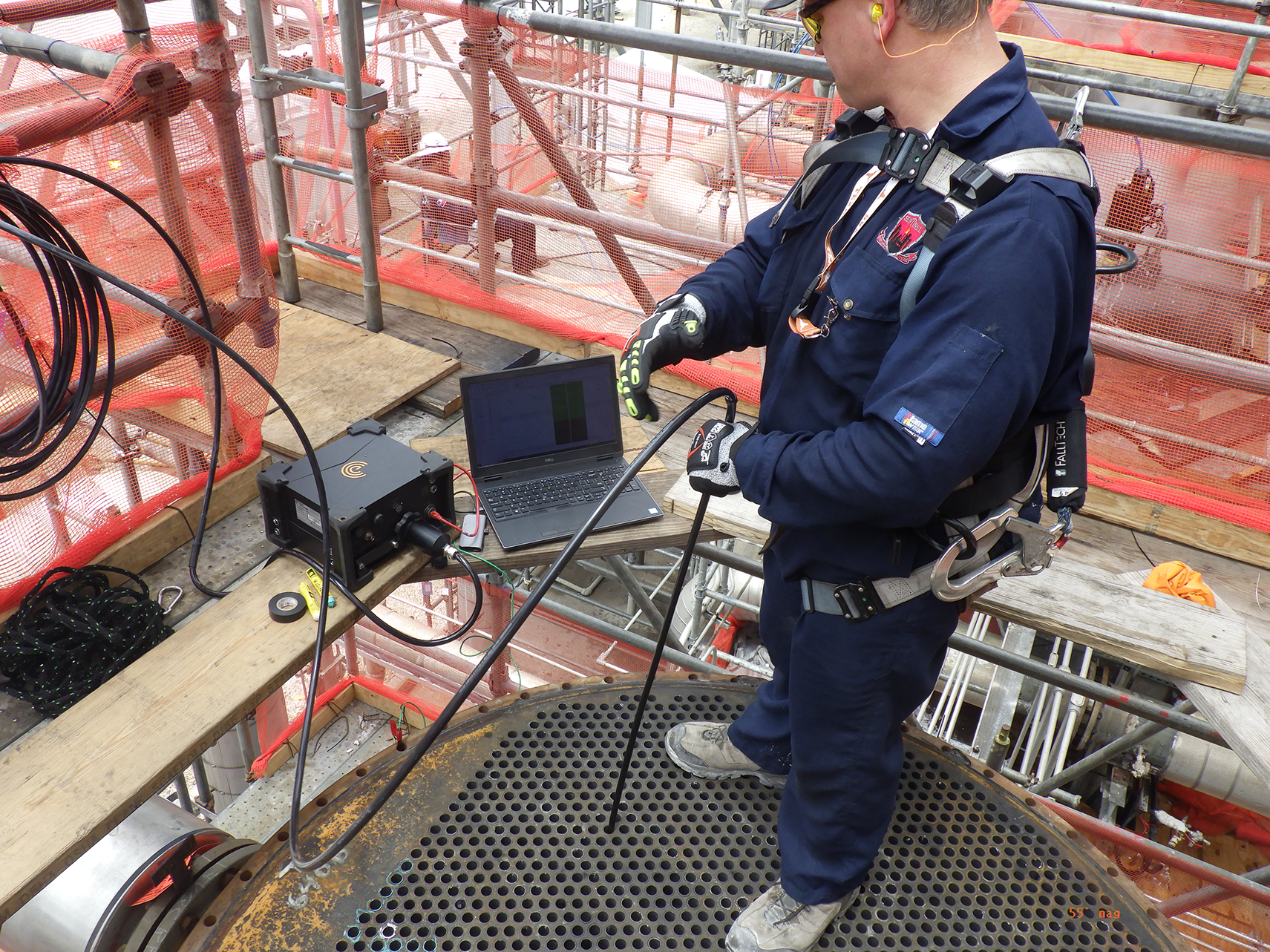
Product overview
The Remote-Field Array (RFA) Probe family inspects ferrous heat exchanger tubing, with a design focused on carbon steel. It combines a high-density coil array with conventional bobbins and dual drivers to provide C-scan imaging that helps characterize defect morphology and assess tube bundles.
A patent-pending low-frequency multiplexing protocol enables array acquisition at speeds equivalent to conventional remote-field testing. The family uses up to 30 coils and supports heat exchanger tube sizes from 15.8 mm to 31.75 mm (0.625 in to 1.25 in). Conventional, absolute and differential channels are acquired and displayed simultaneously.
Small array sensors increase sensitivity to pits and other small defects near tubesheets and support plates. In general, RFA reduces blind zones around these external features by up to 75% compared with standard RFT inspections. Integrated centering devices maintain constant liftoff in field conditions and improve sizing on both standard and array signals.
Inspection uses the same cleaning and fill factor preparation requirements as conventional RFT, with a typical pulling speed of 300 mm/s or 12 in/s. Acquisition and analysis require Magnifi PRO version 5.1 or higher and one of the specified Ectane 3 instrument configurations.
Key capabilities
High-resolution C-scans
A high-density coil array provides imaging for improved interpretation of defect morphology.
Low-frequency multiplexing
A patent-pending multiplexing protocol supports array imaging at conventional RFT acquisition speeds.
Detection near external features
Small sensors improve sensitivity to pits and small defects close to tubesheets and support plates.
Reduced blind zones
In general, blind zones around external features are reduced by up to 75% compared with standard RFT inspections.
Familiar inspection preparation
Cleaning and fill factor requirements match those of conventional RFT.
Integrated centering
Centering devices maintain constant liftoff and improve sizing capabilities on standard and array signals.
Simultaneous signal acquisition
Conventional, absolute and differential channels are acquired and displayed simultaneously.
Published technical specifications
Values as published by Eddyfi Technologies. Where models or variants differ, each is listed separately.
Probe design
- Coils
- up to 30 coils
- Supported heat exchanger tube sizes
- 15.8 mm to 31.75 mm (0.625 in to 1.25 in)
Performance
- Blind-zone reduction compared to standard RFT
- up to 75%
Data analysis
- Magnifi software required
- PRO, 5.1 and higher for acquisition and analysis
- ABS signal representation
- Impedance or voltage plane
- Number of frequencies
- 2
- Driver activation
- independent
- Data modes
- Conventional and array (C-scan)
Specifications
- Recommended fill factor
- 78% or more
- Diameters available
- 11.0 mm (0.433 in) to 23.0 mm (0.906 in)
- Typical pulling speed
- 300 mm/s or 12 in/s
- Frequency range
- 50 – 2,000 Hz
- Number of drivers
- 2
- Material
- Ferrous (designed for carbon steel)
- Cable sheath
- 9 mm (0.375 in) or 12.7 mm (0.5 in) strong, premium, non-kinking nylon
- Connector
- 41-pin
- Protective sleeve
- Stainless steel
- Centering devices
- Ceramic feet with foam induced pressure
- Instrument model required
- Ectane 3-E64RNM(I) or Ectane 3-E128RNM(I)
- Integrated centering devices with ceramic feet and foam induced pressure
- Stainless steel protective sleeve
- Magnifi PRO, 5.1 and higher
- Ectane 3-E64RNM(I)
- Ectane 3-E128RNM(I)
- For ferrous tubing; designed for carbon steel.
- Supports heat exchanger tube sizes ranging from 15.8 mm to 31.75 mm (0.625 in to 1.25 in).
- Recommended fill factor is 78% or more.
- Requires the same cleaning and fill factor preparation as conventional RFT.
- Acquisition and analysis require Magnifi PRO, 5.1 and higher.
- Requires Ectane 3-E64RNM(I) or Ectane 3-E128RNM(I).
- The stated blind-zone reduction is up to 75% compared with standard RFT inspections.
Compatibility lists only items named by Eddyfi for this product; confirm configuration with EMUS before ordering.
Product videos
Official brochures
Tubing Probe Catalog
Additional documents
Remote-Field Array (RFA) Probes Technical Specifications
Remote-Field Array (RFA) Probes Technical SpecificationsOther Eddyfi products
Alternatives from other manufacturers
Comparable systems we also represent. If your application requires a different balance of speed, resolution or footprint, these are worth reviewing.
Structure & Hardness Test Instruments
ibg's family of digital eddy-current instruments for 100% comparative verification of heat treatment, hardness, case depth and material mix-ups on mass-produced steel parts.
Compareibg NDT TechnologyeddyQlab Ai
Laboratory system that uses eddy-current data and a pre-trained AI model to predict case depth and surface hardness of induction-hardened parts such as CV joints.
Compareibg NDT TechnologyeddyQlab Ai VL
Semi-automated, one-button lab system for CV joints that predicts surface hardness and case depth non-destructively using AI and machine learning.
Compareibg NDT Technologyeddyguard neo S
Next-generation eddy-current controller for microstructure testing, built for easy machine integration, Industrial Ethernet connectivity and multi-device control.
CompareHow EMUS supports this
Equipment is only part of the answer. Every system we supply is backed by regional engineering, service and application support.
Mechanical, electrical, environmental setup done right the first time.
Qualification and acceptance testing against real criteria.
Operator and application training built around your parts.
Traceable calibration to keep measurements audit-ready.
Preventive and corrective service across the Balkan region.
Method development and problem-solving with our engineers.
Eddyfi Technologies
Part of the Eddyfi Technologies portfolio, represented by EMUS across the Balkan region.
Application Notes & resources
Official application notes and technical literature for Remote-Field Array (RFA) Probe.
Request an Engineering Consultation
Talk to an EMUS engineer about this product and whether it fits your inspection workflow.