Pulsed Eddy Current Underwater Probes
Underwater PEC probes used with Lyft measure remaining wall thickness beneath marine growth or coatings for offshore corrosion inspection at depths up to 100 m.
Product overview
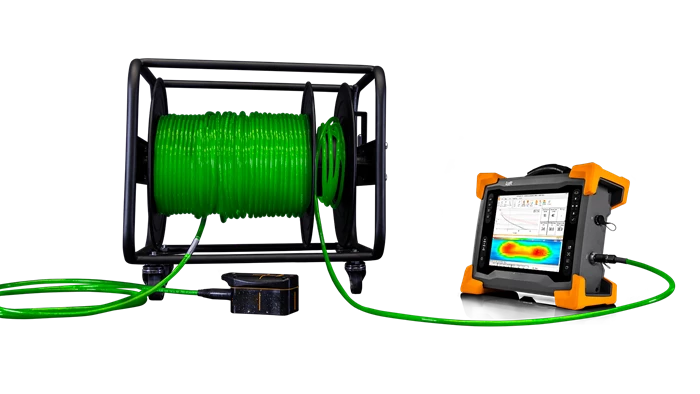
Pulsed Eddy Current Underwater Probes are diver-deployed sensors for assessing corrosion in submerged offshore components. Used with the Lyft PEC system, they measure remaining wall thickness beneath marine growth or coatings without requiring surface preparation.
The probes apply pulsed eddy current inspection to examine components through the material covering their surface. Small, Medium, and Large sizes provide different supported wall thicknesses, covering thicknesses, and inspection footprints; the Large probe supports walls up to 100 mm (4 in) thick and insulation or coatings from 0–300 mm (0–12 in).
Rated for depths of 100 m (330 ft), the probes offer 50 m (165 ft) or 100 m (330 ft) cables for subsea deployment. Embedded status LEDs help divers coordinate inspection activity with the topside team when examining risers, jetty piles, caissons, and underwater piping systems.
Key capabilities
Inspection without surface preparation
PEC inspection measures remaining wall thickness beneath marine growth or coatings without surface preparation.
Subsea depth rating
The probes are watertight to 100 m (330 ft).
Embedded status LEDs
Probe-mounted LEDs improve diver control and synchronization with the topside inspection team.
Three probe sizes
Small, Medium, and Large probes support different wall thicknesses, covering thicknesses, and footprints.
Thick-wall inspection
The Large probe supports component wall thicknesses up to 100 mm (4 in).
Cable length choices
Cable lengths of 50 m (165 ft) and 100 m (330 ft) are listed.
Lyft operation
The underwater probes operate with the Lyft PEC system.
Published technical specifications
Values as published by Eddyfi Technologies. Where models or variants differ, each is listed separately.
GENERAL
- Probe sizes
- Small; Medium; Large
- Encoder
- None (add-on only)
- Depth rating
- 100 m (330 ft)
- Cable
- 50 m (165 ft)
- Cable
- 100 m (330 ft)
- Maximum surface temperature
- Direct contact operation: 70°C (158°F)
Small
- Supported wall thicknesses
- Up to 19 mm (0.75 in)
- Supported insulation/coating thicknesses
- 0–76 mm (0–3 in)
- Footprint at zero liftoff
- 35 mm (1.38 in)
Medium
- Supported wall thicknesses
- Up to 75 mm (3 in)
- Supported insulation/coating thicknesses
- 0–200 mm (0–8 in)
- Footprint at zero liftoff
- 62 mm (2.4 in)
Large
- Supported wall thicknesses
- Up to 100 mm (4 in)
- Supported insulation/coating thicknesses
- 0–300 mm (0–12 in)
- Footprint at zero liftoff
- 100 mm (3.9 in)
Features
- Marine growth depth
- up to 305 mm (12 in)
Details
- Insulation and marine growth thickness
- as thick as 300 mm (12 in)
- Encoder (add-on only)
- Lyft
- Depth rating: 100 m (330 ft).
- Maximum surface temperature for direct contact operation: 70°C (158°F).
- Supported wall thickness and insulation/coating thickness depend on probe size.
- Footprint values are specified at zero liftoff.
- No encoder is provided except as an add-on.
- The Features section states marine growth up to 305 mm (12 in), while Details states 300 mm (12 in) and the Large probe specification lists 0–300 mm (0–12 in) for insulation/coating thickness.
Compatibility lists only items named by Eddyfi for this product; confirm configuration with EMUS before ordering.
Product videos
Official brochures
Alternatives from other manufacturers
Comparable systems we also represent. If your application requires a different balance of speed, resolution or footprint, these are worth reviewing.
Structure & Hardness Test Instruments
ibg's family of digital eddy-current instruments for 100% comparative verification of heat treatment, hardness, case depth and material mix-ups on mass-produced steel parts.
Compareibg NDT TechnologyeddyQlab Ai
Laboratory system that uses eddy-current data and a pre-trained AI model to predict case depth and surface hardness of induction-hardened parts such as CV joints.
Compareibg NDT TechnologyeddyQlab Ai VL
Semi-automated, one-button lab system for CV joints that predicts surface hardness and case depth non-destructively using AI and machine learning.
Compareibg NDT Technologyeddyguard neo S
Next-generation eddy-current controller for microstructure testing, built for easy machine integration, Industrial Ethernet connectivity and multi-device control.
CompareHow EMUS supports this
Equipment is only part of the answer. Every system we supply is backed by regional engineering, service and application support.
Mechanical, electrical, environmental setup done right the first time.
Qualification and acceptance testing against real criteria.
Operator and application training built around your parts.
Traceable calibration to keep measurements audit-ready.
Preventive and corrective service across the Balkan region.
Method development and problem-solving with our engineers.
Eddyfi Technologies
Part of the Eddyfi Technologies portfolio, represented by EMUS across the Balkan region.
Application Notes & resources
Official application notes and technical literature for Pulsed Eddy Current Underwater Probes.
Request an Engineering Consultation
Talk to an EMUS engineer about this product and whether it fits your inspection workflow.