Spyne Array Probe
Spyne combines flexible eddy current array probes with dual-axis encoding for rapid screening of cracks, hard spots and pitting on ferrous and non-ferrous assets.
Product overview
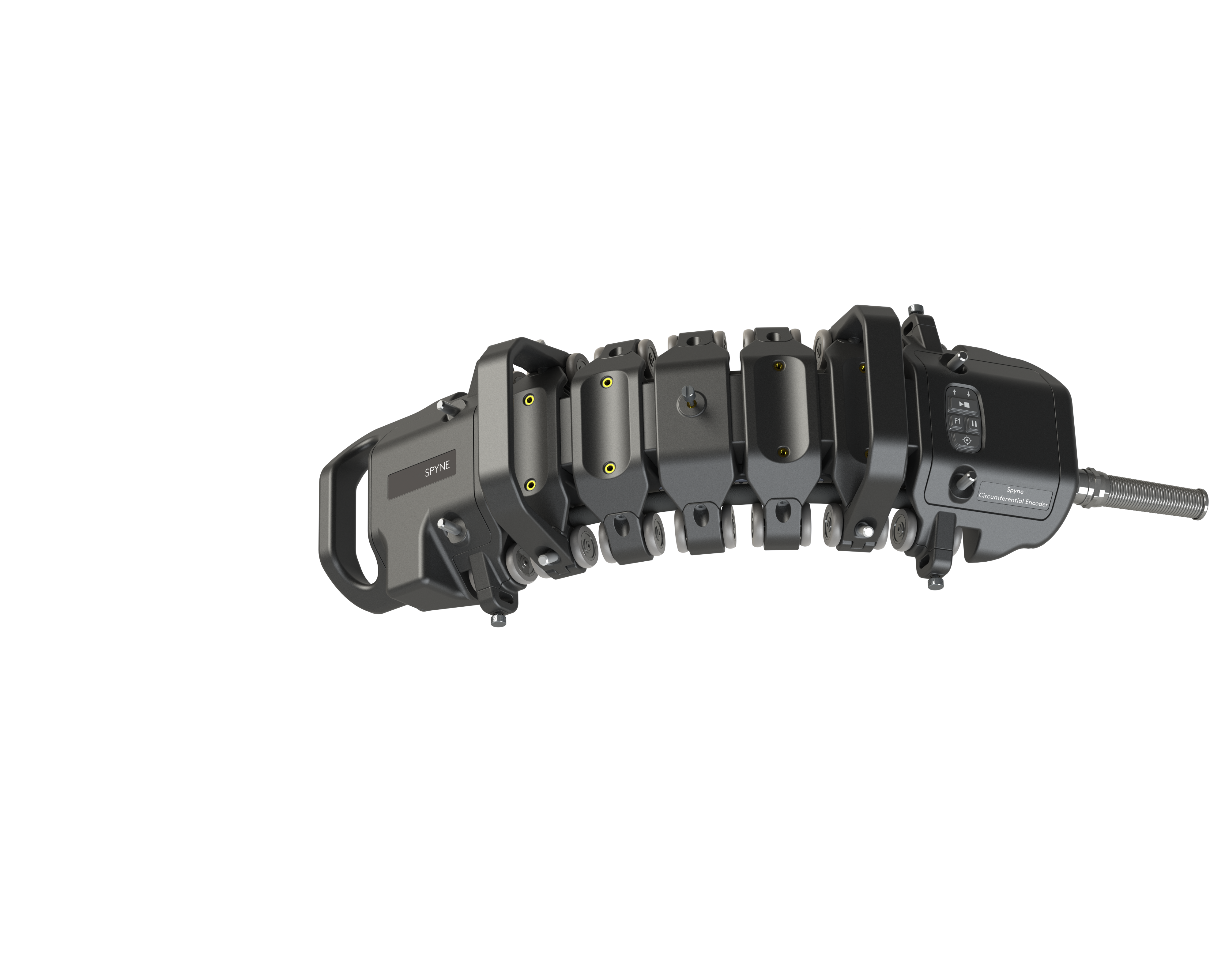
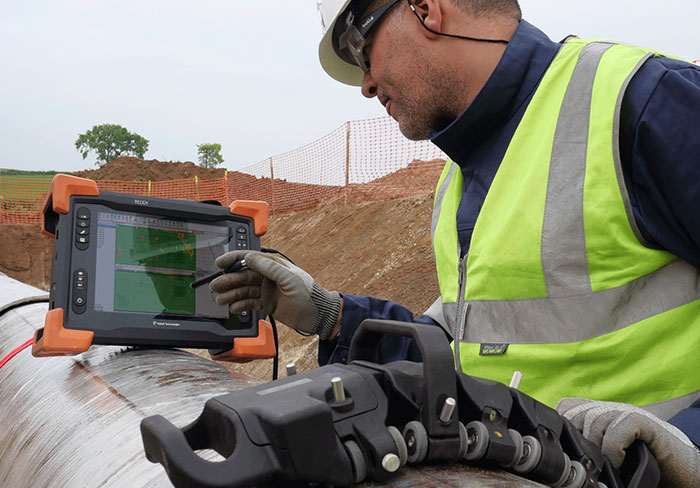
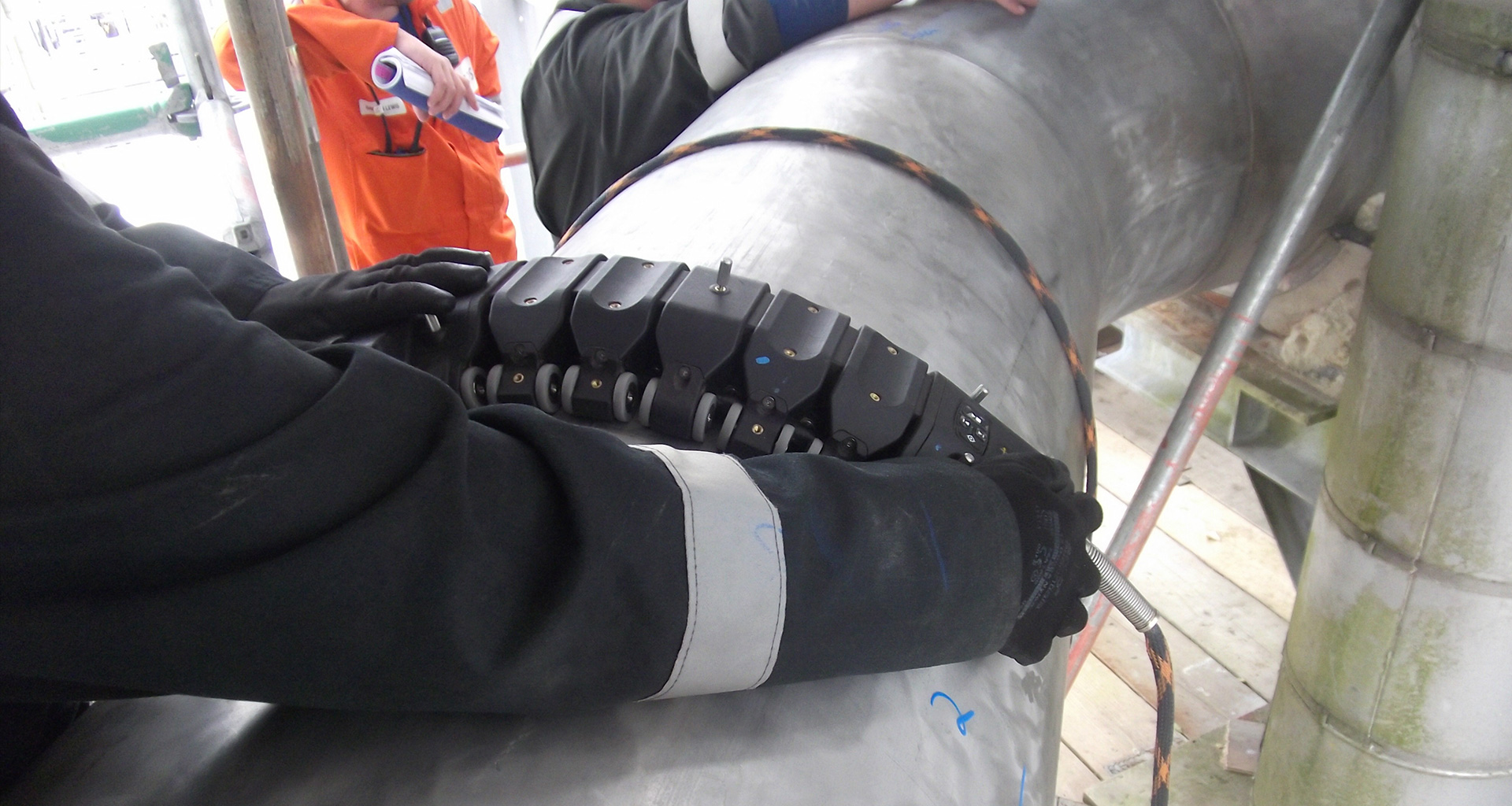
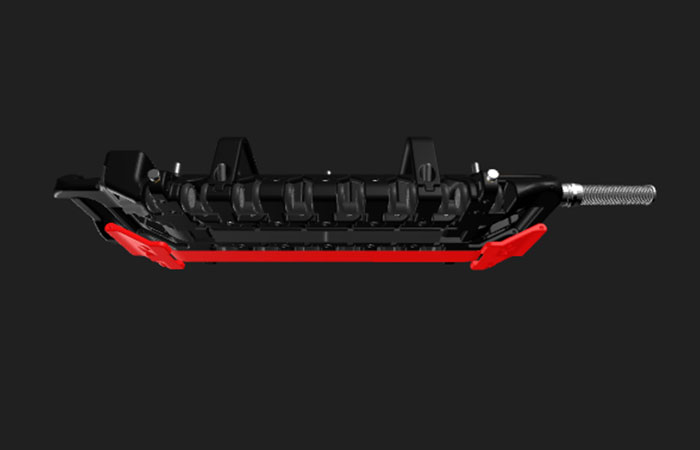
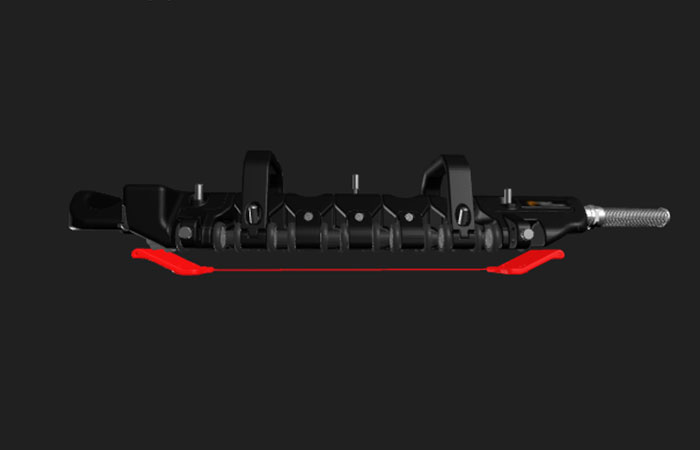
Spyne is a surface eddy current array (ECA) screening tool for pipelines, tanks, pressure vessels and other critical components. Interchangeable flexible PCB probes adapt it to ferrous or non-ferrous materials, supporting detection of surface-breaking cracks, subsurface defects and other material-specific indications. Its adjustable configuration accommodates external pipe diameters from 150 mm (6 in) to flat surfaces.
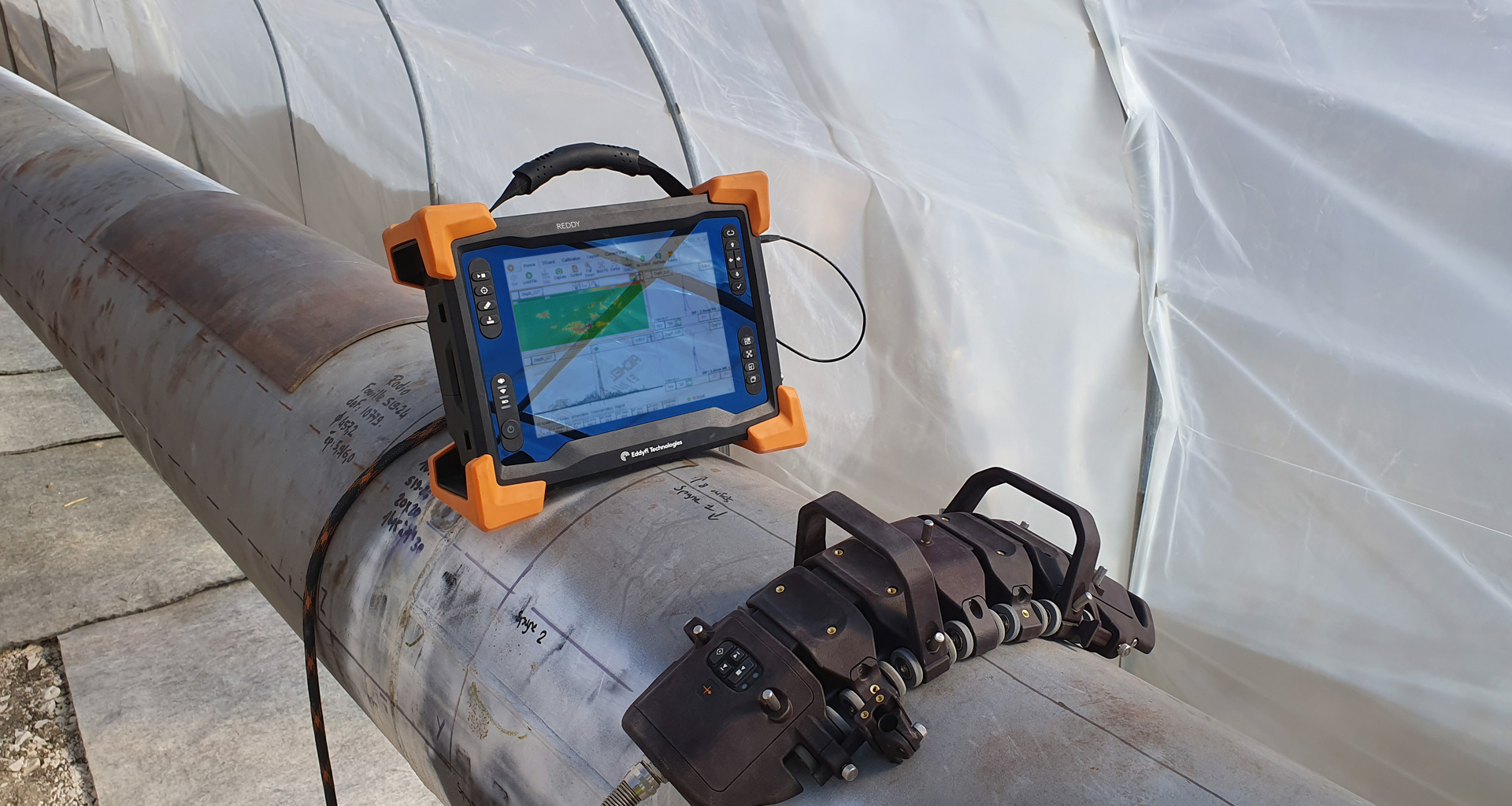
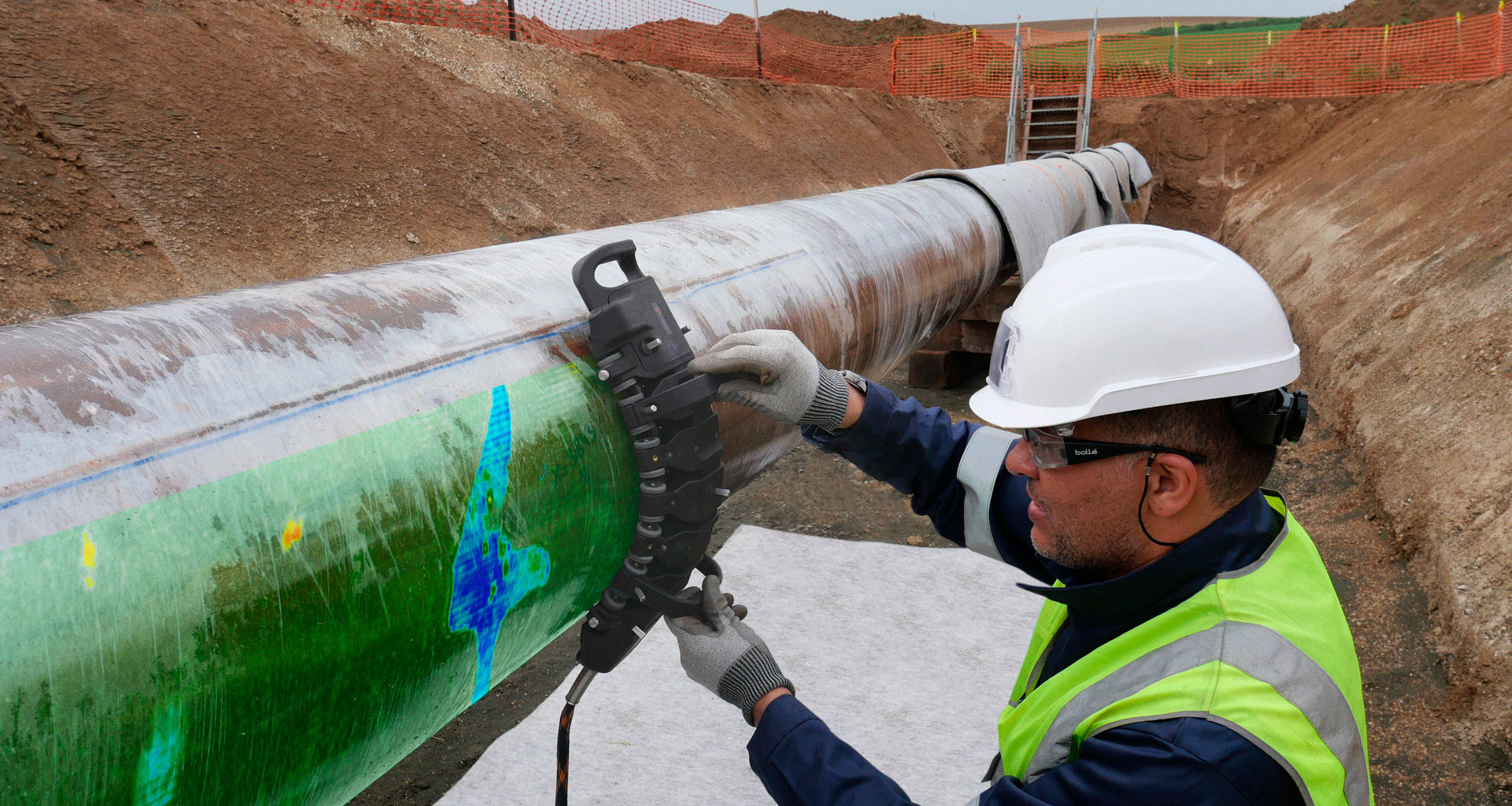
The flexible ECA probe collects inspection data while a spring-loaded wheel records axial position and a gyroscopic device tracks circumferential position. Raster scanning combines these measurements into a single data file covering the pipe exterior, with nominal single-pass coverage of 200 mm (8 in). The system supports inspection through non-conductive coatings and paints with liftoff monitoring and automatic correction, up to the stated 3 mm (0.12 in) tolerance.
Typical work includes pipeline stress corrosion cracking assessment, hard-spot detection, seam-weld indication screening and early-stage chloride stress corrosion cracking detection in stainless steel. Ferrous and non-ferrous probe variants have distinct element arrangements, coil dimensions and flaw-detection specifications. Spyne is specified for surface temperatures up to 150ºC (302ºF); the higher emulsion-pipeline operating temperature discussed on the page is application context, not a higher probe rating.
Magnifi displays encoded results as C-scans and automatically highlights indications using an adjustable signal threshold. SIMS PRO ECA can import the data for mapping, standardized reporting, repair tracking and traceability, with depth-sizing reports supported by complementary techniques. Pre-calibration reduces setup work to a calibration check, while optional magnetic wheels assist scanning along pipe sides and undersides.
Key capabilities
Dual-axis encoding
Gyroscopic circumferential encoding and a spring-loaded axial encoder locate indications around and along the pipe.
Flexible interchangeable probes
Spring-loaded flexible ECA probes can be exchanged for ferrous and non-ferrous inspection applications.
Wide single-pass coverage
Nominal 200 mm (8 in) coverage supports rapid screening of large surfaces.
Raster and comb scanning
Full raster and comb scan capability supports recording the complete pipe exterior in a single data file.
Coating tolerance
Non-conductive coatings and paints can remain in place within the specified liftoff tolerance, with monitoring and automatic correction.
High-temperature operation
Spyne supports use on surfaces up to 150ºC (302ºF).
Assisted detection
Magnifi automatically highlights C-scan indications according to an adjustable detection threshold.
Integrated reporting
SIMS PRO ECA supports inspection-data mapping, standardized reports and traceability.
Ergonomic controls
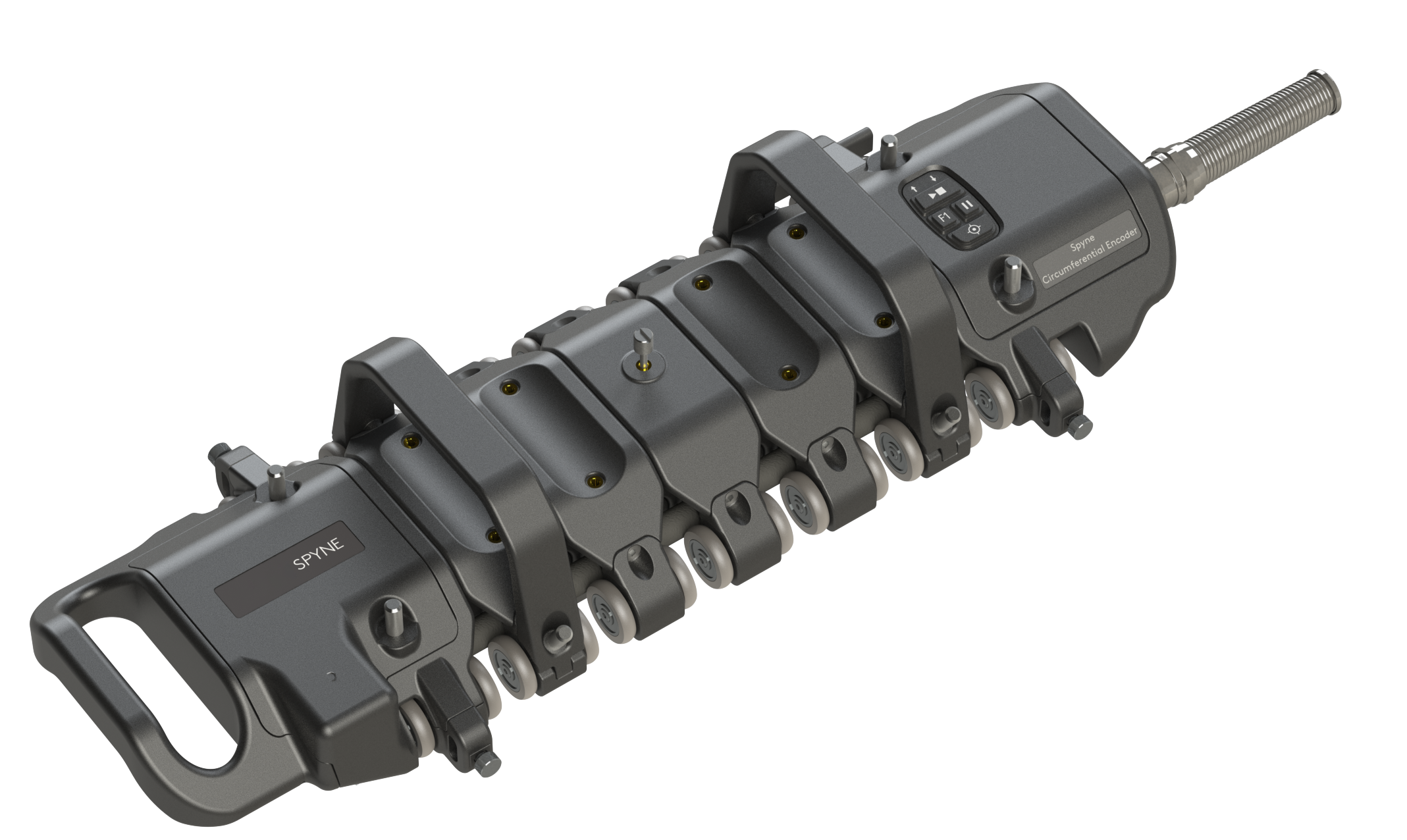
Handles incorporate acquisition control buttons, and the embedded spring-loaded encoder is detachable.
Pre-calibrated setup
The pre-calibrated system requires only a calibration check before inspection.
Published technical specifications
Values as published by Eddyfi Technologies. Where models or variants differ, each is listed separately.
Spyne
- Compatible instruments
- Reddy or Ectane3 (128 Channels)
- Pipe diameter range
- 150 mm (6 in) OD to flat surfaces
- Scan speed
- Up to 600 mm/s (48 in/s)
- No. of channels
- 128
- Maximum liftoff tolerance
- Up to 3 mm (0.12 in)
- Liftoff conditions
- Non-conductive coatings and paints, with monitoring and auto-correction
- Operating temperature
- Up to 150ºC (302ºF)
- Cable length
- 5 m (16.4 ft), 10 m (32.8 ft) or 15 m (49 ft)
Spyne — general performance
- Single-pass coverage
- 200 mm (8 in)
- Individual crack detection stated in Details
- 2mm (0.080in) long and 1mm (0.040in) deep
- Raster scan external surface coverage
- 100%
Spyne — hard-spot mapping
- Circumferential map
- 360-degree
ECA ferrous
- Part No.
- ECA-SPYNE-C-202-250-086
- No. of elements
- 126 (85 Axial, 41 Transverse)
- Coverage
- Up to 202 mm (8 in)
- Topology
- Long single driver
- Coil diameter
- 4.5 mm (0.18 in)
- Smallest detectable flaw
- Crack: 2 mm (0.080 in) L × 0.5 mm (0.020 in) Dia
- Central frequency
- 250 kHz
- Frequency range
- 50-500 kHz
ECA non-ferrous
- Part No.
- ECA-SPYNE-D-200-250-066
- No. of elements
- 128 (64 Axial, 64 Transverse)
- Coverage
- Up to 200 mm (7.9 in)
- Topology
- Short double driver
- Coil diameter
- 6 mm (0.24 in)
- Smallest detectable crack
- Crack: 2 mm (0.080 in) L × 0.5 mm (0.020 in) D
- Smallest detectable pit
- Pit: 0.5 mm (0.020 in) L × 0.5 mm (0.020 in) D
- Central frequency
- 250 kHz
- Frequency range
- 50-500 kHz
Automatic detection and reporting
- Default detection threshold
- 0.50V
Emulsion pipeline application context — not probe rating
- Pipeline operating temperature
- up to 185°C/365°F
- Magnetic wheels to facilitate scanning the sides and bottom of the pipe
- Reddy
- Ectane (128 channels)
- Ectane3 (128 Channels)
- Magnifi
- SIMS PRO ECA
- Eddyfi mobile application
- OneDrive
- Adjustable for external pipe diameters from 150 mm (6 in) OD to flat surfaces.
- Operating surface temperature is limited to up to 150ºC (302ºF).
- Liftoff tolerance is up to 3 mm (0.12 in) for non-conductive coatings and paints, with monitoring and automatic correction.
- Ferrous and non-ferrous applications require the corresponding suitable PCB probe.
- A calibration check is required despite pre-calibration.
- The detection threshold should be adjusted to the minimum defect size required for the inspection.
- Depth-sizing reports in SIMS PRO ECA use complementary techniques.
Compatibility lists only items named by Eddyfi for this product; confirm configuration with EMUS before ordering.
Typical applications
- Pipeline stress corrosion cracking direct assessment
- Pipeline hard-spot detection
- Hydrogen induced cracking
- Fatigue crack detection
- ERW weld lack of fusion, hook cracks and fatigue cracks
- A.O Smith flash-weld lack of fusion, cold welds and stitching
- Seam-weld indications in DSAW, ERW and AO Smith welds
- Manufacturing flaws, mill scabs and weld splatters
- Surface and subsurface crack detection
- Intergranular stress corrosion cracking in emulsion pipelines
- Chloride stress corrosion cracking in stainless steel
- Corrosion pits in non-ferrous alloys
- Storage tanks and LNG tank floors
- Pressure vessels
- Food and beverage stainless steel tanks
- Yellow Jacket™ piping
- Corrosion underneath coatings
Product imagery
Product videos
Official brochures
Spyne User Manual
ECA Surface Probe Catalog
Other Eddyfi products
Alternatives from other manufacturers
Comparable systems we also represent. If your application requires a different balance of speed, resolution or footprint, these are worth reviewing.
Structure & Hardness Test Instruments
ibg's family of digital eddy-current instruments for 100% comparative verification of heat treatment, hardness, case depth and material mix-ups on mass-produced steel parts.
Compareibg NDT TechnologyeddyQlab Ai
Laboratory system that uses eddy-current data and a pre-trained AI model to predict case depth and surface hardness of induction-hardened parts such as CV joints.
Compareibg NDT TechnologyeddyQlab Ai VL
Semi-automated, one-button lab system for CV joints that predicts surface hardness and case depth non-destructively using AI and machine learning.
Compareibg NDT Technologyeddyguard neo S
Next-generation eddy-current controller for microstructure testing, built for easy machine integration, Industrial Ethernet connectivity and multi-device control.
CompareHow EMUS supports this
Equipment is only part of the answer. Every system we supply is backed by regional engineering, service and application support.
Mechanical, electrical, environmental setup done right the first time.
Qualification and acceptance testing against real criteria.
Operator and application training built around your parts.
Traceable calibration to keep measurements audit-ready.
Preventive and corrective service across the Balkan region.
Method development and problem-solving with our engineers.
Eddyfi Technologies
Part of the Eddyfi Technologies portfolio, represented by EMUS across the Balkan region.
Application Notes & resources
Official application notes and technical literature for Spyne Array Probe.
Request an Engineering Consultation
Talk to an EMUS engineer about this product and whether it fits your inspection workflow.